Loading page
Core line, represented 25+ years
Swiss turning
Swiss turning is a screw machine method where a sliding headstock pushes bar stock through a guide bushing, and the tools cut right next to the bushing, so the part is always supported. It holds ±0.0002–0.0005 in (±0.005–0.013 mm) on diameters up to about 1.25 in (32 mm), handles length-to-diameter ratios past 10:1, and pays off from about 1,000 parts.
A method under screw machine products.
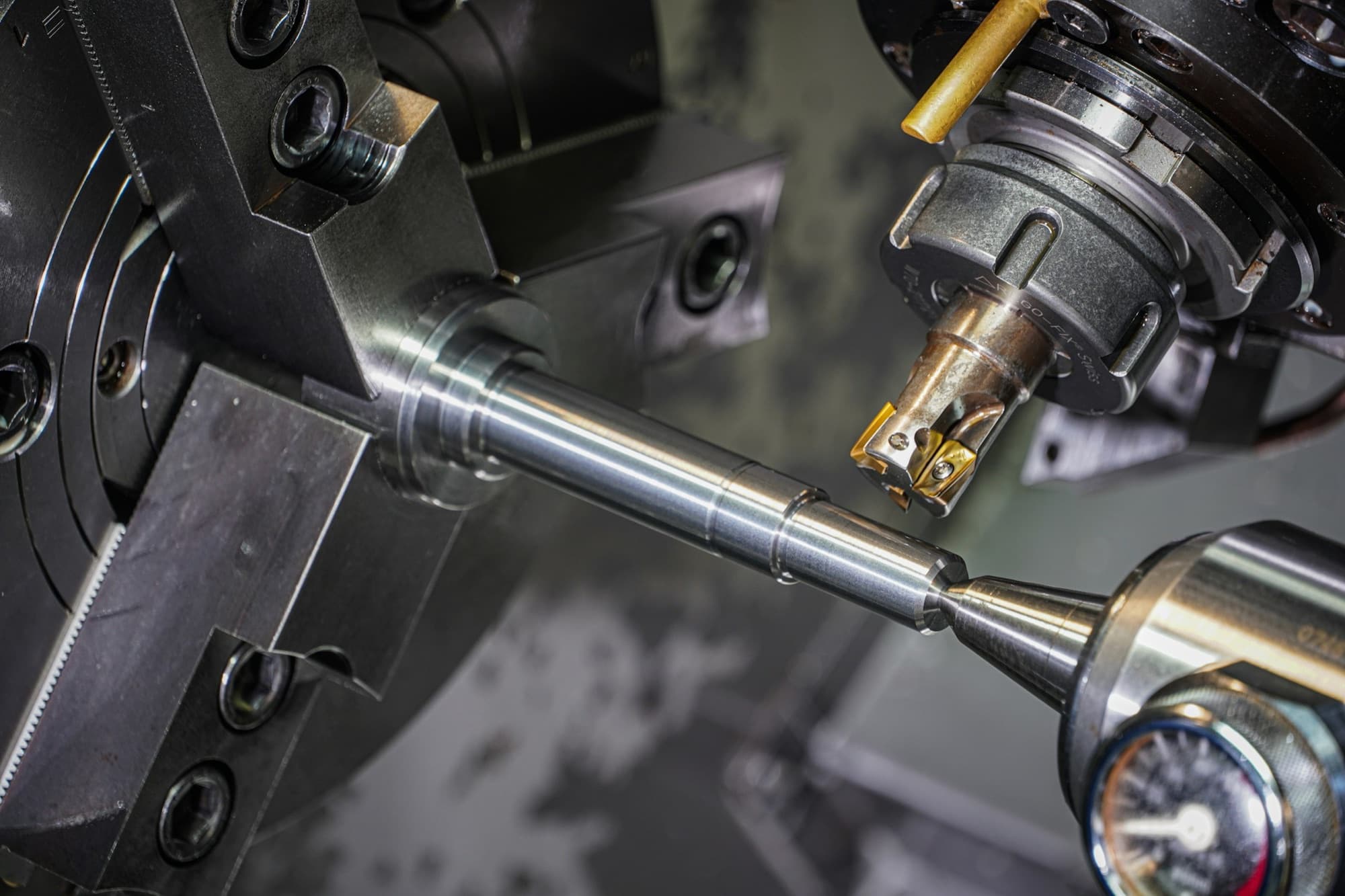
How does swiss turning work?
The schematic plays while it is on screen. Pick a phase to hold it there.
- 1
Bar through the guide bushing
Bar from a 12 ft (3.7 m) bar feeder is held in the headstock collet and passes through a guide bushing fixed in front of the tools.
- 2
Headstock moves, tools cut at the bushing
The headstock slides the bar forward along Z while radial tools cut it right at the bushing, so the cut never happens far from support.
- 3
Live tools add features
Cross drills, slotting saws and end mills cut flats, holes and hex forms while the bar is held in position.
- 4
Sub-spindle picks the part
A second spindle grips the part as it is cut off, and back-works the other end: facing, drilling, threading.
- 5
Eject and repeat
The finished part drops into a catcher, often with coolant washed off, and the next cycle starts with no operator touch.
What can swiss turning hold?
Typical ranges across principals. Your drawing, material and quantity set the real numbers in the quote.
| Bar diameter | 0.020–1.25 in (0.5–32 mm); most machines 20–32 mm |
|---|---|
| Diameter tolerance | ±0.0002–0.0005 in (±0.005–0.013 mm) |
| Length-to-diameter | 10:1 routine; 20:1 and more with care |
| Finish | 16–32 µin Ra (0.4–0.8 µm) achievable |
| Cycle time | 30 seconds to 3 minutes typical |
| Setup | 4–8 hours |
| Economic volume | 1,000–1,000,000 parts |
| Lead time | 2–5 weeks typical |
When is swiss turning the right call?
Best for
- Small, precise turned parts under 1.25 in (32 mm) diameter
- Long, slender pins, shafts and screws with L/D of 10:1 or more
- Complex parts done complete: turned, cross-drilled, milled and back-worked in one cycle
- Medical, electronic connector, fluid-power and firearm components
Pick something else when
- Diameters over about 1.25 in (32 mm): conventional CNC turning
- Simple parts at 100,000+ a year: cam or CNC multi-spindle machines are faster per part
- Short runs under a few hundred parts: 4–8 hour setups make a CNC lathe cheaper
How does swiss turning compare with the alternatives?
Typical values. Pick an alternative to see where each one wins.
Swiss turning compared with
Swiss turningCNC turning
- Precisionlooser → tighter
- Volume it pays atone-offs → millions
- Upfront toolingnone → heavy
- Shape freedomnarrow → wide
Swiss turning · pick it when
Small, long, slender turned parts under 1.25 in (32 mm) diameter with milled or cross-drilled features.
CNC turning · pick it when
Round parts over about 1.25 in (32 mm) diameter, or short parts with low length-to-diameter ratio.
About CNC turningMethodTypical toleranceEconomic volumeToolingLead time
- Swiss turningthis pageTypical tolerance±0.0002–0.0005 in (±0.005–0.013 mm) on diametersEconomic volume1,000–1,000,000 partsToolingNone; setup 4–8 hoursLead time2–5 weeks
- Typical tolerance±0.001 in (±0.025 mm) on diametersEconomic volume10–10,000 parts per orderToolingNone; standard inserts and jawsLead time1–3 weeks
- Typical tolerance±0.001–0.002 in (±0.025–0.05 mm)Economic volume50,000 parts and upToolingCams and form tools $1,000–$5,000Lead time3–6 weeks
Which design rules keep swiss turning affordable?
Rules of thumb principals apply at DFM review. Each one has a reason.
RuleTargetWhy
- Diameter
- ≤ 1.25 in (32 mm)
- Above the machine's bar capacity the part moves to a conventional lathe.
- Bar tolerance
- Use ground or precision-drawn bar
- The guide bushing needs bar within about 0.0005 in (0.013 mm) to support without binding.
- Cross holes
- ≥ 0.020 in (0.5 mm) diameter
- Smaller drills are possible but slow the cycle and break more often.
- Remnant
- Allow 6–10 in (150–250 mm) per bar
- The last length of each bar cannot be held. It is built into the material cost.
- Tight features
- Keep the critical diameter near the bushing end
- Features cut close to the bushing are the most accurate.
What drives the cost of swiss turning?
In order of impact.
- 1
Cycle time
The biggest driver at volume. Live-tool milling and back-working add seconds that multiply across the run.
- 2
Setup
4–8 hours of setup and prove-out, spread across the order. At 500 parts it can exceed the run time.
- 3
Material
Ground bar costs more than cold-drawn bar. Stainless and titanium cost more and cut slower.
- 4
Tolerance and inspection
Features under ±0.0002 in (±0.005 mm) need in-process gauging and sometimes 100% inspection.
- 5
Secondary operations
Heat treat, plating, passivation and grinding are usually outside operations with their own lead time.
Budgetary estimate for a small stepped pin from bar, from the same estimator as the part builder. Change a size, the quantity or the material and the price updates.
Turned shaft · Screw machining
Order total $14,757
- Tooling
- $1,800
- one-time, spread over the order
- Piece price
- $1.17
- before setup + tooling
- Lead time
- 4–6 weeks
- to first production
Size
Drag a row to adjust · click to type
Major diameter16.016.0 mm
Overall length60.060.0 mm
Step diameter10.010.0 mm
Quantity
Price per part falls as volume rises
Exact quantity1000010000 pcs
Material
Design checks pass
Open in builderBudgetary estimate for a representative part. Firm quotes come from principals after drawing review.
Swiss turning questions
What makes a Swiss lathe different from a regular CNC lathe?
On a Swiss lathe the bar moves and the tools stay close to a guide bushing, so the cut is always supported. On a conventional lathe the bar is fixed in the chuck and the tool travels away from it, so long, thin parts deflect.
What is the largest part a Swiss machine can make?
Most Swiss machines take bar up to 20–32 mm (0.79–1.25 in). A few run 38 mm (1.5 in). Length is limited more by the part catcher and sub-spindle than the machine, but parts over 12 in (300 mm) are unusual.
How many parts justify Swiss turning?
About 1,000 parts and up is typical, because setup takes 4–8 hours. Below that a CNC lathe or mill-turn is usually cheaper unless the part is too slender to hold any other way.
Is Swiss turning the same as screw machining?
Swiss turning is one kind of screw machining. The term covers cam-driven and CNC multi-spindle machines too. Swiss-type machines are single-spindle and better suited to complex, precise parts.
Can Swiss machines hold tolerances without grinding?
Often, yes. ±0.0002–0.0005 in (±0.005–0.013 mm) on diameters is routine, with 16–32 µin Ra finish. Bearing fits tighter than that still go to grinding.
Quote swiss turning with a rep.
Send a STEP file and drawing. A rep routes the RFQ to principals that run this method every day, and brings back firm quotes.