Loading page
Core line, represented 25+ years
Springs, wire forms, and fourslide
Custom spring and wire form manufacturing is the coiling and bending of round wire or flat strip into compression, extension, and torsion springs, clips, hooks, and retainers on CNC coilers, CNC wire formers, and fourslide machines. Typical wire diameters run 0.008–0.500 in (0.2–12.7 mm), and most coiled springs need no dedicated tooling, so runs of a few hundred parts are practical.
Where it pays off
1101001k10k100k1M+
At a glance
CNC coilers need little or no dedicated tooling, so runs of a few hundred springs are practical. Fourslide tooling pays back above a few thousand parts.
- Wire diameter
- 0.008–0.500 in (0.2–12.7 mm) typical for cold-coiled springs
- Load tolerance
- ±10% commercial; ±5% achievable with added testing or sorting
- Free length tolerance
- About ±1.5–3% depending on spring index
- Spring index (D/d)
- 4–12 preferred
- End squareness
- About 3° on closed and ground ends
- Service temperature
- Music wire to about 250 °F (120 °C); 302 stainless to about 550 °F (290 °C)
- Fourslide capacity
- Strip up to about 3 in (76 mm) wide and 0.100 in (2.5 mm) thick, typical
- Tooling cost
- None for most CNC-coiled springs; about $1,000–$10,000 for fourslide and forming tools
Lead time
- Tooling
- None for most CNC-coiled springs; 3–6 weeks for fourslide tooling
- First article
- 1–3 weeks
- Production
- 2–5 weeks per release
What would it cost?
The builder's estimator on a representative compression spring. Change a size, the quantity or the material and the price updates.
Compression spring · Springs & wire forms
Order total $1,282
- Tooling
- None
- no hard tooling
- Piece price
- $0.11
- before setup + tooling
- Lead time
- 1–3 weeks
- to first production
Size
Drag a row to adjust · click to type
Wire diameter1.201.20 mm
Outside diameter12.012.0 mm
Free length40.040.0 mm
Quantity
Price per part falls as volume rises
Exact quantity1000010000 pcs
Material
Design checks pass
Open in builderBudgetary estimate for a representative part. Firm quotes come from principals after drawing review.
How does it work?
5 steps from drawing to production parts.
- 1
Wire selection
Wire grade, diameter, and temper are chosen for load, stress, temperature, and corrosion. Music wire and 302 stainless cover most applications.
- 2
Coiling or forming
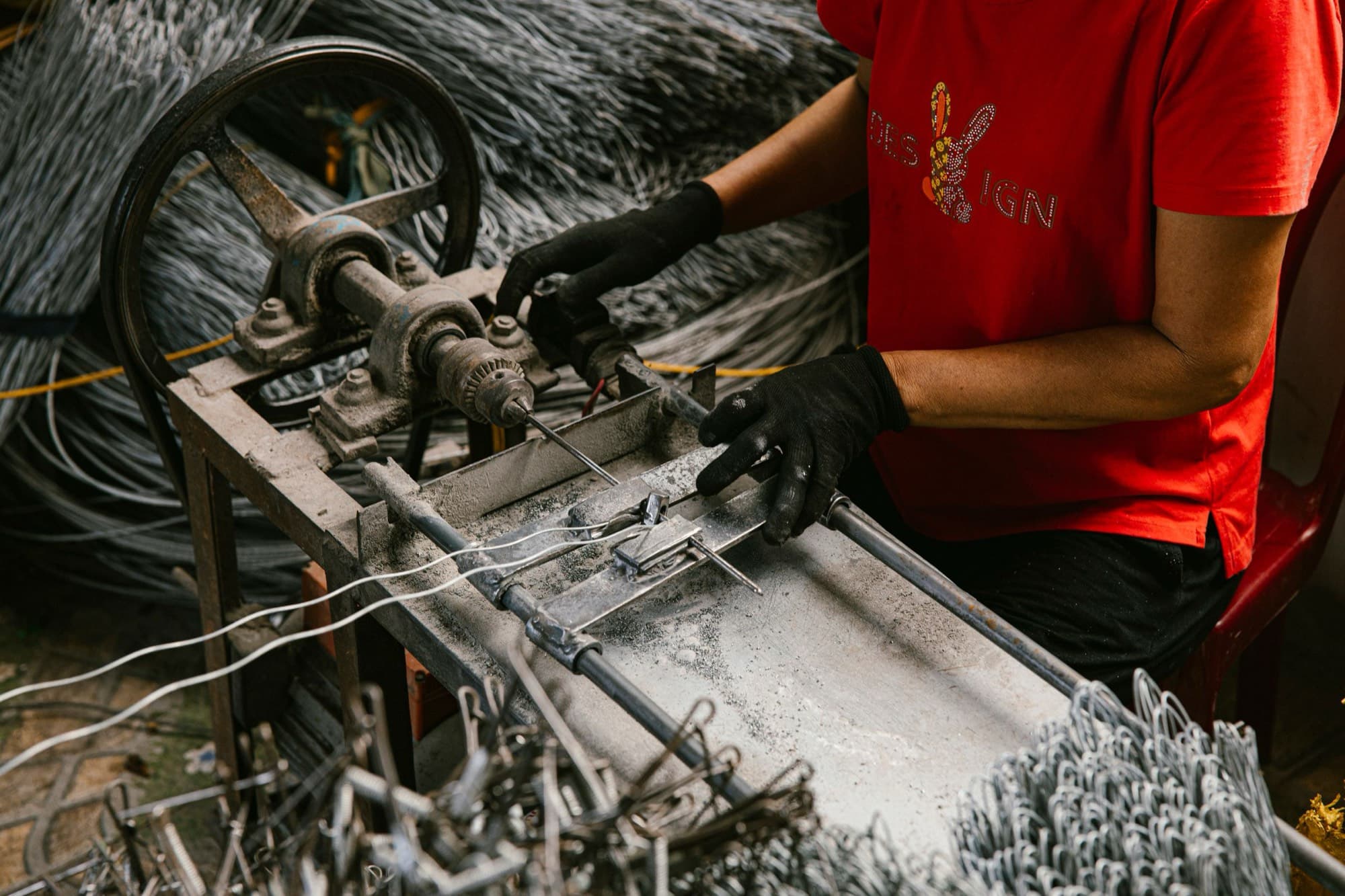
CNC coilers feed wire against point and pitch tools to form coils. CNC wire formers and fourslides bend wire or strip with rotating heads or cam-driven slides.
- 3
Stress relief
Springs are baked, typically at 450–650 °F (230–345 °C) for carbon and stainless grades, to relieve coiling stress and stabilize dimensions.
- 4
Grinding and secondary operations
Compression spring ends are ground square where specified, and extension springs get hooks or loops. Shot peening or presetting may be added to raise fatigue life.
- 5
Load testing and finishing
Springs are checked for free length, rate, and load at height. They are then plated, coated, or passivated as needed.
When is springs & wire forms the right call?
Best for
- Compression, extension, and torsion springs
- Wire forms such as hooks, handles, guards, clips, and retainers
- Fourslide clips, clamps, and contacts from flat strip or wire
- Runs from a few hundred to millions of parts with little tooling
- Springs built to a specified load and rate
Pick something else when
- Flat parts with many holes or large flat areas: use metal stamping
- Standard sizes in small quantities: buy catalog stock springs
- Round turned parts such as pins and bushings: use screw machining
Materials
6 materials principals run in springs & wire forms. Pick one for design rules, finishes and an estimate in that material.


Design rules that keep the price down
D/d between 4 and 12
Keep the spring index in range
Below 4 the wire is hard to coil and highly stressed; above 12 springs tangle and vary in size.
Inside radius at least 1× wire diameter
Minimum bend radius
Tighter bends crack or overstress the wire.
Use no more than about 80–85% of available deflection
Leave travel before solid
Coils close unevenly near solid, so rate becomes nonlinear and stress rises.
Free length no more than about 4× mean diameter unless guided
Check buckling
Slender compression springs buckle unless they run in a bore or over a rod.
Give load at one or two working heights, with free length as reference
Specify loads, not everything
Specifying rate, loads, and every dimension over-constrains the spring and forces sorting.
Hook bend inside radius at least 2× wire diameter
Size extension spring hooks
Tight hook bends concentrate stress and are the usual failure point.
Closed and ground ends give about 3° squareness
Call out ground ends only when needed
Ground ends seat flat and load evenly but add an operation.
Specify hydrogen embrittlement relief per ASTM B850
Bake after plating
Electroplating can embrittle hardened spring wire and cause delayed cracking.
What drives the cost?
In order of impact.
- 1
Wire material and size
Stainless and phosphor bronze cost several times more than music wire. Heavier wire needs larger machines and slower cycles.
- 2
Load and dimensional tolerance
Holding load to ±5% instead of ±10% may require 100% testing or sorting. Specify only the loads and dimensions that matter to function.
- 3
Setup and run length
CNC coilers set up in an hour or two, but setup still spreads across the run. Short runs carry a higher cost per part.
- 4
Form complexity
Wire forms with many bends, tight radii, or special ends need slower cycles or custom tooling.
- 5
Secondary operations
End grinding, shot peening, presetting, and plating each add a step and handling.
Variants
- Compression springs
- Open-coil helical springs that resist being pushed together. Ends can be open, closed, or closed and ground.
- Extension springs
- Close-wound springs with hooks or loops that resist being pulled apart. Initial tension is wound in during coiling.
- Torsion springs
- Springs whose legs rotate around the coil axis to apply torque, as in hinges, latches, and return mechanisms.
- CNC wire forms
- Wire is bent in 2D or 3D on CNC benders into hooks, handles, guards, and clips, often with no dedicated tooling.
- Fourslide and multislide parts
- Four or more tool slides form wire or flat strip around a center post in one cycle. Suits clips, clamps, and contacts with multiple bends.







Springs & wire forms questions
What is the difference between music wire and stainless spring wire?
Music wire (ASTM A228) has the highest tensile strength of common spring wires and costs the least, but it rusts and is limited to about 250 °F (120 °C). Type 302 stainless (ASTM A313) resists corrosion and runs to about 550 °F (290 °C), at roughly 15% lower strength and higher cost.
What tolerances can custom springs hold?
Commercial load tolerance is typically ±10%, and ±5% is achievable with added testing or sorting. Free length and diameter tolerances depend on spring index and wire size, commonly ±1.5–3% of free length. The Spring Manufacturers Institute publishes standard tolerance tables.
Do custom springs need tooling?
Most compression, extension, and torsion springs made on CNC coilers need no dedicated tooling, only setup. Fourslide parts and complex wire forms may need custom tooling, typically $1,000–$10,000.
What is the minimum order for custom springs?
Many spring makers treat a few hundred to a few thousand pieces as a practical minimum, set by a lot charge rather than tooling. Prototype quantities of 10–50 are often available at a higher unit price.
What is fourslide forming?
Fourslide forming is a process in which four tool slides, driven by cams or servos, bend wire or flat strip around a center form in one cycle. It makes clips, clamps, and brackets with multiple bends at high speed and with less tooling than a progressive die.
Why do plated springs break?
Electroplating can drive hydrogen into hardened spring steel and cause delayed brittle fracture. A hydrogen embrittlement relief bake per ASTM B850, mechanical zinc plating, or stainless wire prevents it.
Quote springs & wire forms today.
Drop a STEP file for an instant estimate and DFM check. A rep routes the RFQ to principals who run this process every day.