Loading page
Rapid prototyping: which process fits 1–25 parts
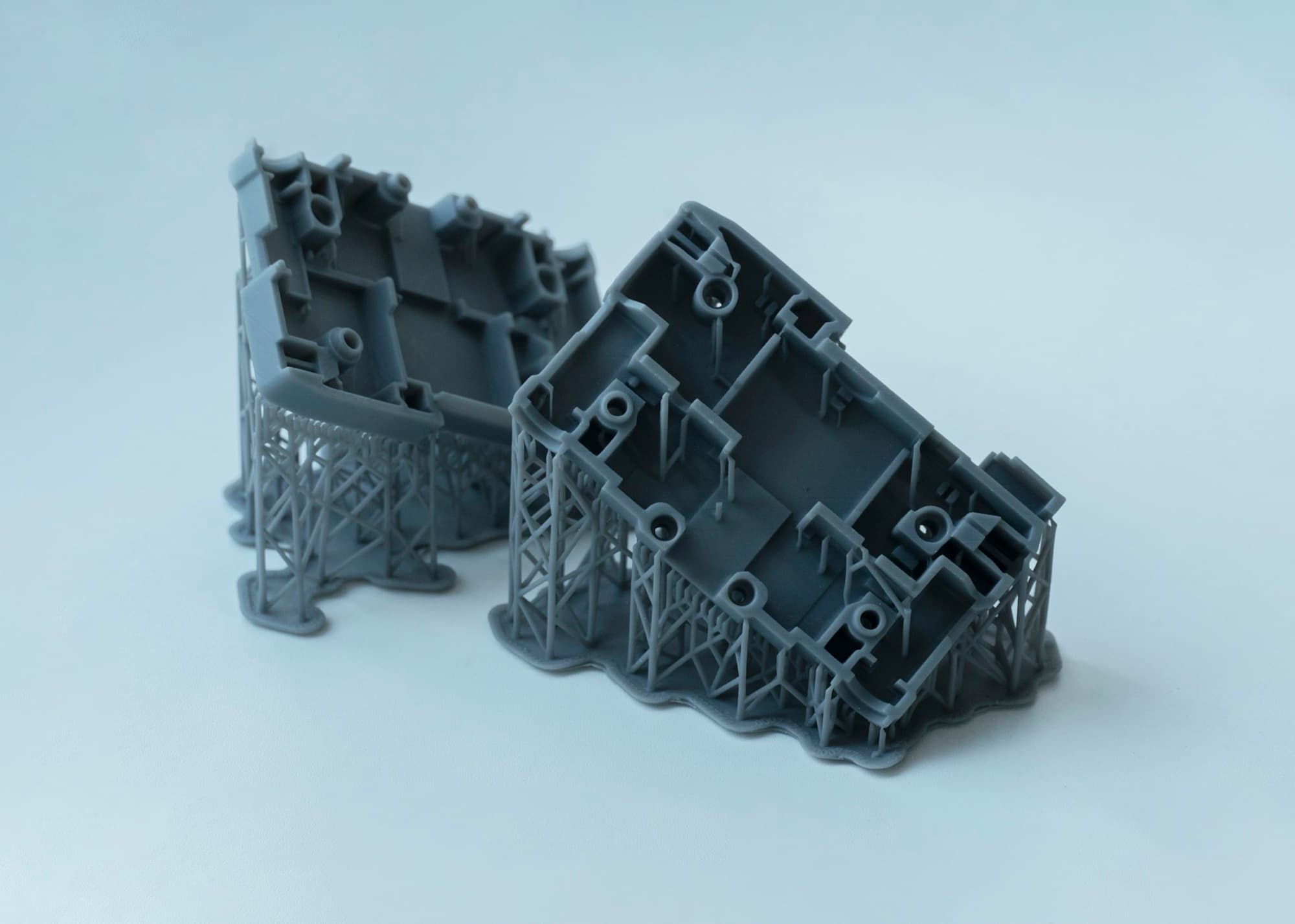
Rapid prototyping means making 1–25 parts fast enough to test a design before paying for production tooling. Plastic parts are typically 3D printed (MJF) in 3–7 days, CNC machined in 5–10 days, urethane cast in 1–3 weeks or molded from a soft aluminum tool in 3–5 weeks. Sheet metal prototypes are laser cut and bent in 5–12 days. Choose by what the part must prove.
- 3D printing (MJF)3–7
- CNC machining5–10
- Prototype sheet metal5–12
- Urethane casting10–16
- Soft tooling20–35
Which prototyping process fits your part?
Pick the part, how many, and what the prototype has to prove. Routes re-rank by fit, then by budgetary price from the builder's estimator.
- 1
3D printing (MJF)Best fit
No tooling · 3–7 days
$40.20$40.20 per part ·
$402$402 total- Yes: Ships in 3–7 days
- 2
No tooling · 5–10 days
$160$160 per part ·
$1,600$1,600 total- Partly: 5–10 days
- 3
$1,009 tooling · 1–2 weeks
$136$136 per part ·
$1,360$1,360 total- No: 1–2 weeks: master pattern, then silicone molds
- 4
$10,017 tooling · 3–5 weeks
$1,047$1,047 per part ·
$10,470$10,470 total- No: 3–5 weeks for the mold
Prices are budgetary all-in estimates from the SSG estimator, tooling included, domestic, standard tolerance. The fit bar shows how much of what you picked each route can prove. Principals return firm quotes after drawing review.
How do the prototyping processes compare?
Typical figures for 1–25 parts. Prices are budgetary all-in at 10 parts: the housing for plastic routes, the bracket for sheet metal.
| Process | Lead time | Typical tolerance | Material | Surface | 10 parts, each |
|---|---|---|---|---|---|
| 3D printing (MJF) | 3–7 days | ±0.012 in (±0.3 mm) | PA12 or PA11 nylon | Grainy grey; dyed black | $40.20 |
| CNC machining | 5–10 days | ±0.005 in (±0.13 mm) | Real ABS, PC, nylon, acetal, aluminum, steel | Tool marks unless blasted or painted | $160 |
| Urethane casting | 1–3 weeks | ±0.010 in (±0.25 mm) first inch | Urethanes simulating ABS, PC, PP, rubber | Production color and texture | $136 |
| Soft tooling | 3–5 weeks | ±0.004–0.005 in (±0.10–0.13 mm) | Your production resin | Molded, SPI finish or texture | $1,047 |
| Prototype sheet metal | 5–12 days | Holes ±0.005 in; bends ±0.010 in | Production sheet and gauge | Powder coat, plate or bare | $15.70 |
- Process
- 3D printing (MJF)
- Lead time
- 3–7 days
- Typical tolerance
- ±0.012 in (±0.3 mm)
- Material
- PA12 or PA11 nylon
- Surface
- Grainy grey; dyed black
- 10 parts, each
- $40.20
- Process
- CNC machining
- Lead time
- 5–10 days
- Typical tolerance
- ±0.005 in (±0.13 mm)
- Material
- Real ABS, PC, nylon, acetal, aluminum, steel
- Surface
- Tool marks unless blasted or painted
- 10 parts, each
- $160
- Process
- Urethane casting
- Lead time
- 1–3 weeks
- Typical tolerance
- ±0.010 in (±0.25 mm) first inch
- Material
- Urethanes simulating ABS, PC, PP, rubber
- Surface
- Production color and texture
- 10 parts, each
- $136
- Process
- Soft tooling
- Lead time
- 3–5 weeks
- Typical tolerance
- ±0.004–0.005 in (±0.10–0.13 mm)
- Material
- Your production resin
- Surface
- Molded, SPI finish or texture
- 10 parts, each
- $1,047
- Process
- Prototype sheet metal
- Lead time
- 5–12 days
- Typical tolerance
- Holes ±0.005 in; bends ±0.010 in
- Material
- Production sheet and gauge
- Surface
- Powder coat, plate or bare
- 10 parts, each
- $15.70
Soft tooling looks expensive at 10 parts because the whole mold lands on them. It is the only row that makes the part the way production will. Head to head: CNC vs 3D printing, urethane vs 3D printing, molding vs 3D printing.
When does a prototype need to be made the way production will be?
When the test depends on how the part is made, not just its shape. A printed housing that survives a drop test says little about a molded one.
A look-alike is enough when you are testing
- Size, shape, ergonomics and appearance.
- Fit with mating parts at nominal dimensions.
- Assembly order, cable routing and access for tools.
- Early user feedback, photography and investor demos.
Make it the production way when you are testing
- Snap fits, living hinges and press fits: they depend on the resin and how it was molded.
- Drop, impact and fatigue: knit lines and molded-in stress set where parts crack.
- Sealing and gaskets: surface finish and flatness from the real process.
- Flammability, UL, biocompatibility or food contact: the certificate names the production resin.
- Tolerance stack-ups across molded or stamped parts: shrink and springback move dimensions.
- Formed metal: a machined bracket is stiffer than the bent one and can hide a weak flange.
The usual path: print or machine the early rounds, then move to soft tooling or a bridge mold for validation builds. See prototype to production for when that tooling pays for itself.
What does each prototype round prove?
Hardware teams usually build in rounds. Each asks a different question and needs a different process.
- 1
Looks-like
3D printing, urethane, paint
Proves size, shape, color and feel for design reviews, user testing and photography. Nothing inside has to work.
- 2
Works-like
3D printing, CNC, prototype sheet metal
Proves the mechanism: fits, clearances, assembly order, snaps and fasteners. Rarely pretty, often a mix of processes.
- 3
Engineering validation (EVT)
CNC, urethane, soft tooling
Proves the design meets its requirements: loads, heat, sealing, tolerances. Material properties start to matter here.
- 4
Design validation (DVT)
Soft tooling or bridge tooling
Proves the frozen design in production materials, for certification, reliability and drop testing.
- 5
Production validation (PVT)
Production tooling
Proves the process: parts off production tools at production rate, measured against the drawing. See prototype to production.
How are sheet metal prototypes made?
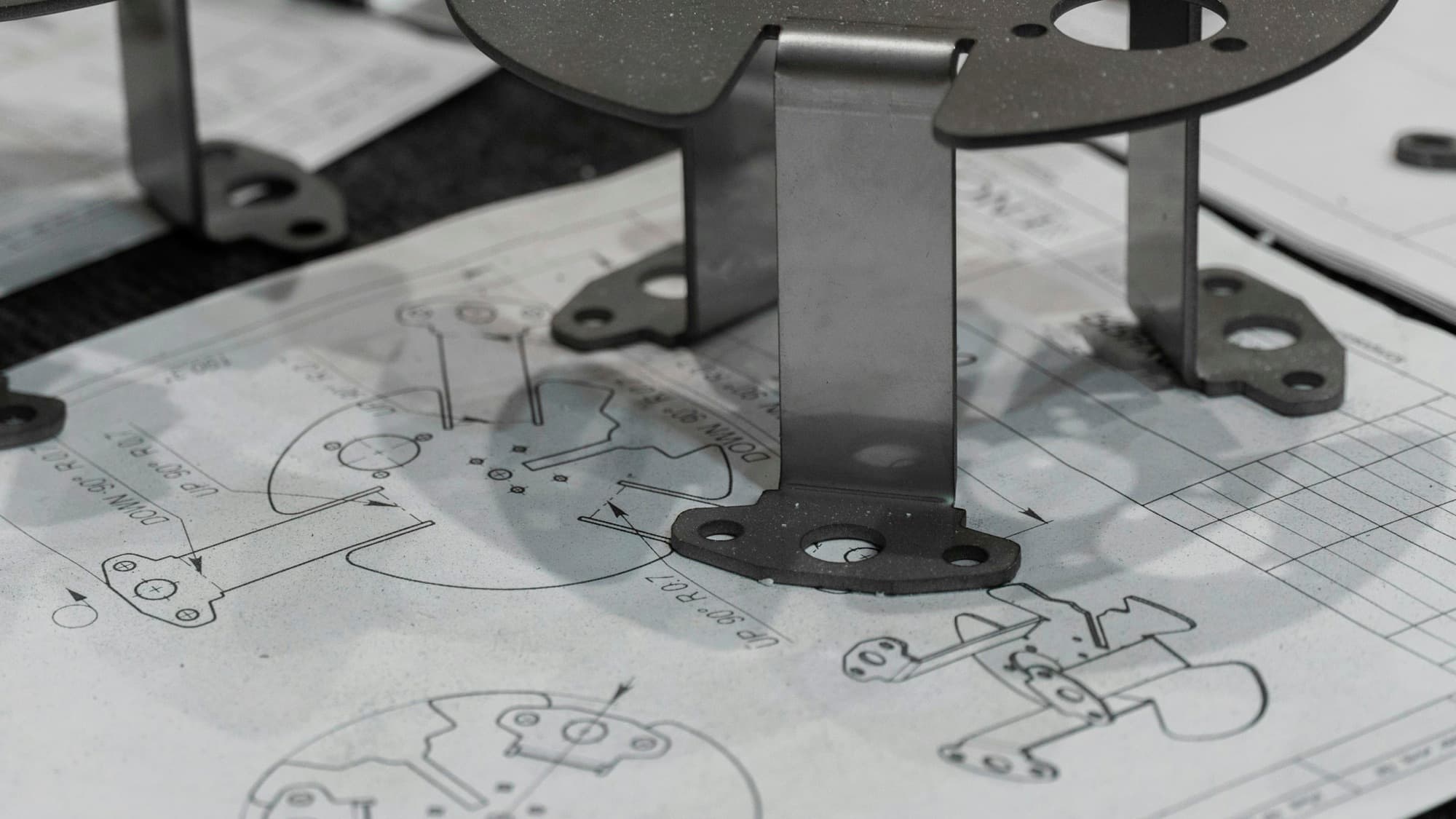
Laser cut from the production sheet, bent on a press brake, then finished. No tooling, so the first part costs about what the tenth does, minus programming and setup.
Inside bend radius≥ 1× thickness
Tighter radii crack, especially in aluminum 6061-T6. 5052-H32 bends cleanly.Minimum flange≈ 4× thickness
Shorter flanges will not sit on the brake die.Hole to bend≥ 2.5× T + R
Closer holes stretch into ovals as the bend forms.Tolerance±0.010 in, ±1°
Laser-cut holes hold about ±0.005 in (±0.13 mm); dimensions across bends about ±0.010 in (±0.25 mm).
For the example bracket, laser and brake stay cheapest up to about 2,100 parts; above that, short-run stamping tooling pays back. See production and stamping vs fabrication.
What drives prototype cost?
At 1–25 parts, fixed costs dominate. These are the levers, in order of impact, with the estimator's numbers for the housing.
- 01
Quantity over setup
Programming, fixturing and setup land on however many parts you order. One machined ABS housing is about $653; at 25 it is about $127 each. Printing barely moves: $45.00 to $37.50. - 02
Process
Untooled processes (printing, machining, laser and brake) win at 1–25 parts. Tooled ones (urethane molds, soft tooling) carry a one-time cost that only pays over more parts or a specific test. - 03
Size and material removed
Printing is priced on part volume and how many fit a build; machining on stock size and minutes of cutting. Hollow, thin-walled parts machine slowly. - 04
Tolerances and finish
Every tight callout adds inspection and slower cutting. Call out the few dimensions that matter and leave the rest to a general tolerance such as ISO 2768-m. - 05
Lead time
Expedites typically cost about 25% more for roughly a third less time. Standard lead time is usually the cheaper way to buy speed: order the first round sooner.
What should a prototype RFQ include?
Enough to quote it once. Missing items become questions, and questions cost days.
- A STEP file, plus a drawing if any dimension is toleranced tighter than the general tolerance.
- Quantity, and the likely next quantity if this round goes well.
- Material and color, or the production material it must stand in for.
- Finish: as-built, bead blast, paint, powder coat, texture.
- What the prototype must prove: fit, function, looks, or a named test.
- The date you need parts in hand, not just the ship date.
- Any certification or material cert the test requires.
- Whether a production-intent route (soft tooling) should be quoted alongside.
More detail: how to write an RFQ, how to choose a process. Teams building hardware: hardware startups, robotics and automation.
Questions about prototyping
What is the fastest way to get a prototype?
3D printing. Multi Jet Fusion nylon parts typically ship in 3–7 days, and small parts can be quoted in hours. CNC machining is next at about 5–10 days, and gives you the real material.
How much does a prototype cost?
It depends most on the process and the quantity. For a 5.5 × 3.5 in (140 × 90 mm) housing, the SSG estimator puts one MJF print near $45.00, and one CNC-machined ABS part near $653 because programming and setup land on a single part. At 25 parts the machined part drops to about $127 each. All budgetary.
Is urethane casting or 3D printing better for 20 parts?
3D printing if the parts are for fit and function and nylon is acceptable: it is faster and usually cheaper. Urethane casting if the parts must look like production, in a production color and texture, or behave like a rubber or clear plastic.
When is soft tooling worth it for prototypes?
When 25 parts must be your production resin, molded, for certification, drop or regulatory testing. An aluminum prototype mold typically costs in the low five figures and takes 3–5 weeks, so it rarely pays on price alone under a few hundred parts.
Can a prototype be made from the production material?
Often, yes. CNC machining cuts real ABS, PC, nylon, acetal, aluminum and steel. Prototype sheet metal uses the production sheet and gauge. Only molding makes the part the way production will, with molded-in stress, knit lines and shrink.
What tolerances can prototypes hold?
Typically ±0.005 in (±0.13 mm) for CNC machining, ±0.010 in (±0.25 mm) for bends on sheet metal, about ±0.010 in (±0.25 mm) for the first inch of a urethane casting and ±0.012 in (±0.3 mm) for MJF prints. Call out only the dimensions that matter.
Price the prototype, then the production part.
Build or upload the part for an instant budgetary estimate across processes, with a DFM check. A rep routes the RFQ to principals who run it.