Loading page
Prototype to production: bridge tooling, design freeze and ramp-up
Moving a part from prototype to production means freezing the design, running a DFM review before any steel is cut, and choosing the tooling that fits the volume. Many programs build an aluminum bridge mold first: it typically costs 30–50% less than a steel mold and ships parts in 3–5 weeks, while the steel production mold takes 6–10 weeks.
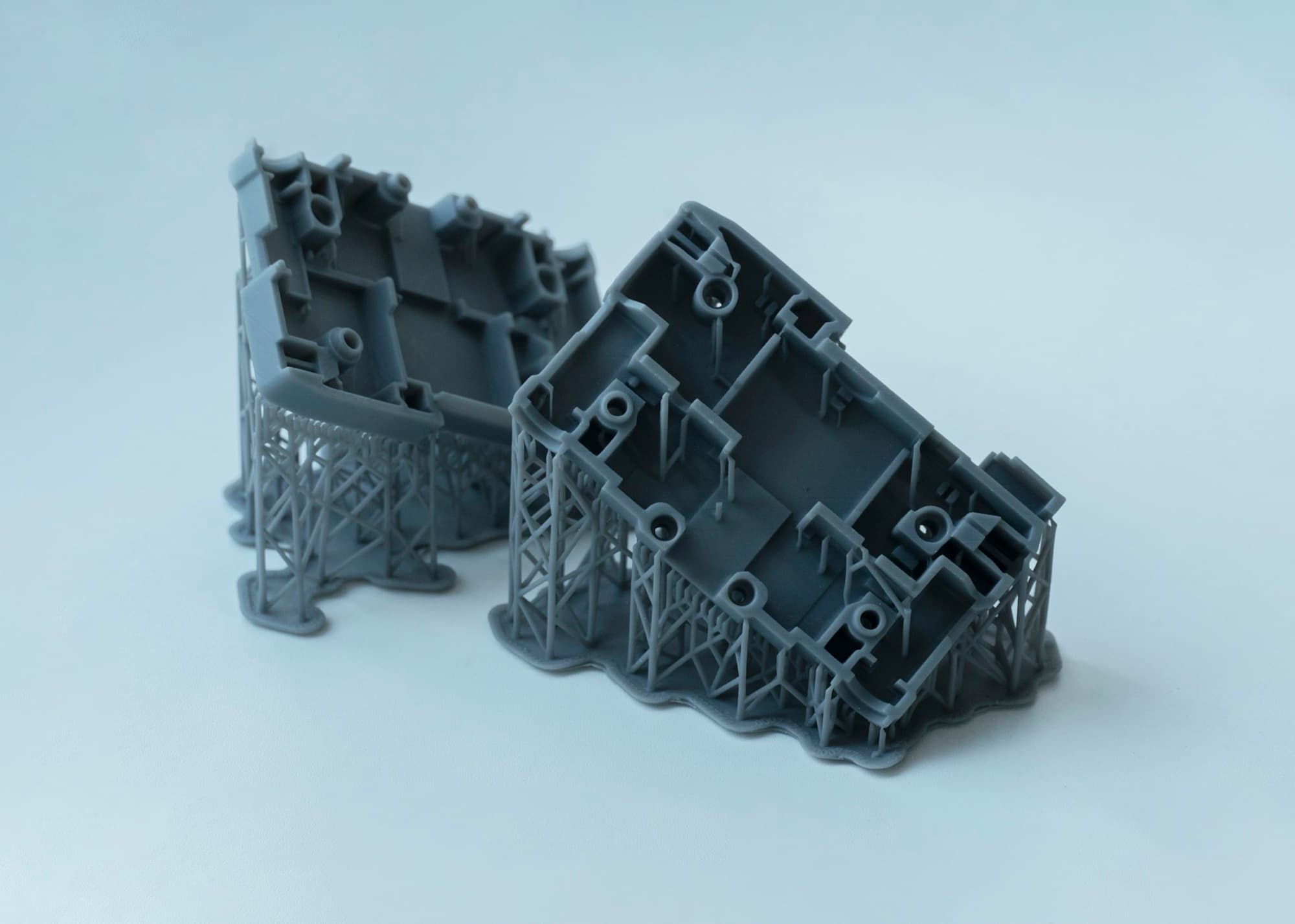
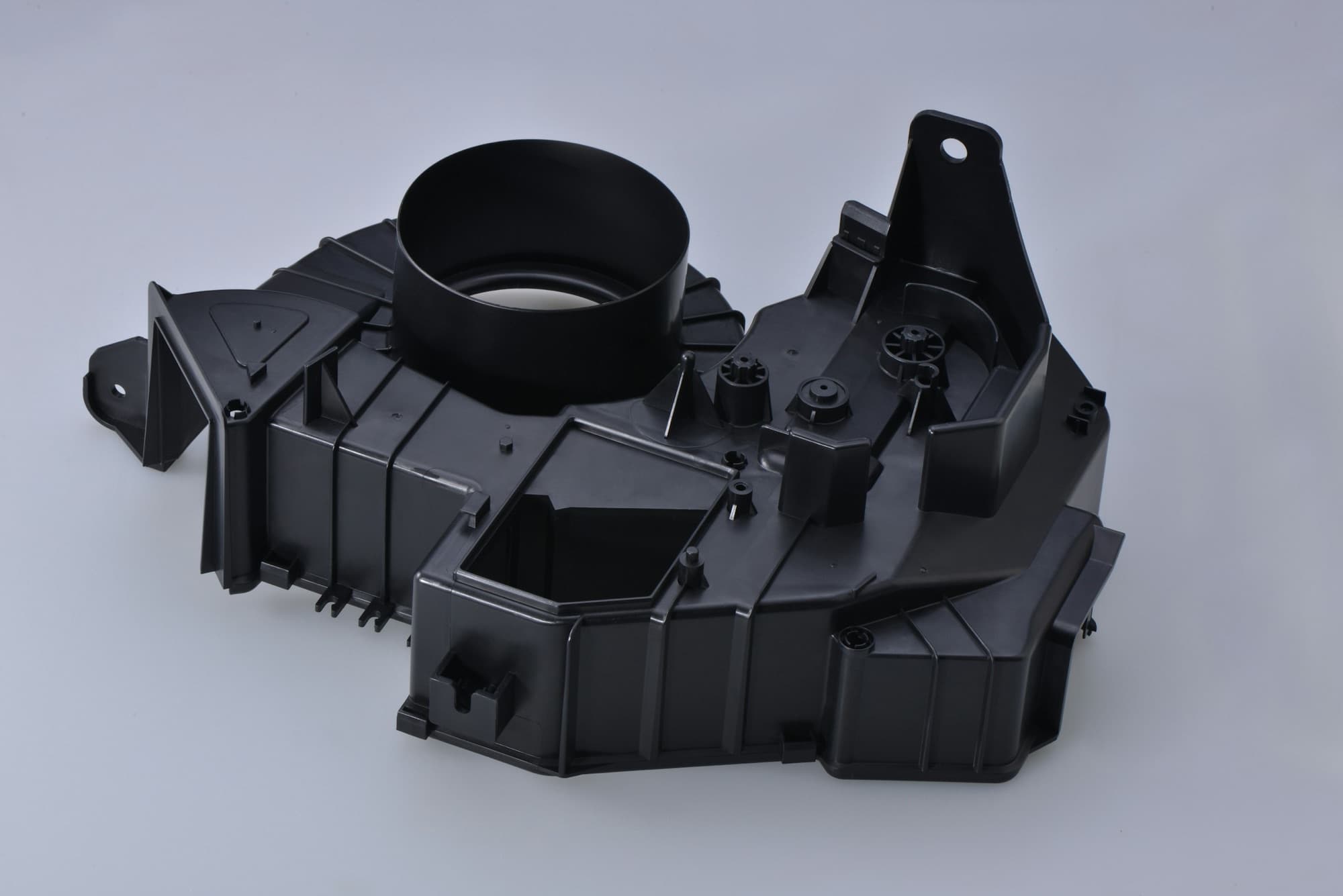
When does tooling pay for itself?
One housing, five ways to make it, priced by the builder's estimator. For this part the aluminum mold beats 3D printing at about 330 parts, and a multi-cavity steel mold beats re-cutting aluminum at about 32,000.
Parts per order
Lowest here: Aluminum bridge mold, $21.36 per part.
- Under 330 parts
- Print or machine it
- No tooling. MJF lands near $40.20 a part at 10 and ships in 3–7 days.
- 330 to 32,000
- Bridge with aluminum
- About $10,000 for a single-cavity mold, parts in 3–5 weeks.
- Over 32,000 parts
- Build steel
- About $46,200 for a 4-cavity P20 mold. Piece price drops to $0.42.
Urethane casting and CNC never win on price for this part. They earn their place on what they prove: a urethane part looks like production, and a machined part is real ABS. Your part's size, wall and resin move every crossover, so price your own part.
What are the steps from prototype to production?
Seven steps from a frozen design to scheduled releases. Who owns each one is under its name.
- 1
Design freeze
You
Lock the revision you will tool. Anything still open goes on a list with an owner and a date; everything else stops changing.
- 2
DFM review
Principal's tooling engineer, with your rep
Draft, wall, gates, parting line, ejection, undercuts and tolerances are checked against the process before mold design starts. Changes cost least here.
- 3
Mold design approval
You sign off
The toolmaker sends the layout: parting line, gate and ejector locations, cooling and any slides. Approve it before steel is ordered.
- 4
Tool build
Toolmaker
Typically 3–5 weeks for an aluminum mold and 6–10 weeks for P20 steel. Hardened, multi-cavity or slide-heavy tools take longer.
- 5
T0 and T1 samples
Principal
First shots are molded and measured. The process is tuned and steel is adjusted to size, usually in one or two loops.
- 6
First article and PPAP
Principal submits, you approve
Every drawing requirement is measured on production-process parts. Automotive and other regulated programs add a PPAP submission.
- 7
Ramp-up
Principal and your rep
Pilot lots at production cycle time, then scheduled releases against your blanket PO while the rep watches delivery and quality.
How long does it take, with and without a bridge?
A bridge mold does not make steel arrive sooner. It puts molded parts in your hands about six weeks earlier, from the process you will produce on.
- First molded parts
- wk
55 - Approved production
- wk
1414
DFM and design freeze
Aluminum bridge mold
Bridge parts shipping
Steel production mold
T1 samples and tuning
First article / PPAP
Production ramp
Aluminum or steel: which mold should you build?
Mold material sets shot life, lead time and how easily the tool takes a change. Budgetary figures are for the example housing.
| Aluminum | P20 steel | Hardened H13 | |
|---|---|---|---|
| Typical shot life | A few thousand to 10,000+ (unfilled resins) | 100,000–500,000 | 500,000 to 1,000,000+ |
| Build time | 3–5 weeks | 6–10 weeks | 10–16 weeks |
| Budgetary, this housing | About $10,000, 1 cavity | About $17,000, 1 cavity; $46,200, 4 cavities | Roughly 1.5× P20 |
| Cycle time | Often shorter: aluminum pulls heat out fast | Baseline | Baseline |
| Design changes | Easy to machine and weld-repair | Machinable; welds need care | Needs EDM, welding and re-hardening |
| Resins | Unfilled ABS, PC, PP, PE, TPE | Most resins, light glass fill | Glass-filled and abrasive resins |
| Best for | Bridge parts, launches under about 10,000, designs still moving | Most production programs | High volume and tight tolerance over millions of cycles |
- Typical shot life
- Aluminum
- A few thousand to 10,000+ (unfilled resins)
- P20 steel
- 100,000–500,000
- Hardened H13
- 500,000 to 1,000,000+
- Build time
- Aluminum
- 3–5 weeks
- P20 steel
- 6–10 weeks
- Hardened H13
- 10–16 weeks
- Budgetary, this housing
- Aluminum
- About $10,000, 1 cavity
- P20 steel
- About $17,000, 1 cavity; $46,200, 4 cavities
- Hardened H13
- Roughly 1.5× P20
- Cycle time
- Aluminum
- Often shorter: aluminum pulls heat out fast
- P20 steel
- Baseline
- Hardened H13
- Baseline
- Design changes
- Aluminum
- Easy to machine and weld-repair
- P20 steel
- Machinable; welds need care
- Hardened H13
- Needs EDM, welding and re-hardening
- Resins
- Aluminum
- Unfilled ABS, PC, PP, PE, TPE
- P20 steel
- Most resins, light glass fill
- Hardened H13
- Glass-filled and abrasive resins
- Best for
- Aluminum
- Bridge parts, launches under about 10,000, designs still moving
- P20 steel
- Most production programs
- Hardened H13
- High volume and tight tolerance over millions of cycles
The SPI mold classes put a number on life: Class 105 is a prototype mold for under 500 cycles, Class 104 runs up to 100,000, Class 103 up to 500,000, Class 102 up to 1 million and Class 101 beyond. Ask for the class on the quote so two toolmakers are pricing the same tool.
Glossary: bridge tooling, cavity, family mold, tooling ownership. Cost detail: injection mold cost guide.
Can urethane casting or 3D printing be the bridge?
Yes, for the right quantity and the right question. Neither proves the molding process; both put parts in hands without a mold.
| Urethane casting | 3D printing (MJF) | Aluminum mold | |
|---|---|---|---|
| Sweet spot | 10–200 parts | 1 to a few hundred | A few hundred to 10,000 |
| Tooling | Master pattern + silicone molds, about 20–25 parts each | None | Machined aluminum mold |
| Lead time | 1–3 weeks | 3–7 days | 3–5 weeks |
| Material | Urethanes that simulate ABS, PC, PP or rubber (30A–85D) | PA12 or PA11 nylon | Your production resin |
| Looks like production | Yes: color-matched, textured, painted | No: grainy grey or dyed black | Yes: molded surface and texture |
| Proves the molding process | No | No | Yes: gates, knit lines, shrink, sink |
| When it loses | Above a few hundred parts, or when the resin itself is being tested | Cosmetic parts, and tolerances tighter than ±0.012 in (±0.3 mm) | Under a few hundred parts, or when the design will change again |
- Sweet spot
- Urethane casting
- 10–200 parts
- 3D printing (MJF)
- 1 to a few hundred
- Aluminum mold
- A few hundred to 10,000
- Tooling
- Urethane casting
- Master pattern + silicone molds, about 20–25 parts each
- 3D printing (MJF)
- None
- Aluminum mold
- Machined aluminum mold
- Lead time
- Urethane casting
- 1–3 weeks
- 3D printing (MJF)
- 3–7 days
- Aluminum mold
- 3–5 weeks
- Material
- Urethane casting
- Urethanes that simulate ABS, PC, PP or rubber (30A–85D)
- 3D printing (MJF)
- PA12 or PA11 nylon
- Aluminum mold
- Your production resin
- Looks like production
- Urethane casting
- Yes: color-matched, textured, painted
- 3D printing (MJF)
- No: grainy grey or dyed black
- Aluminum mold
- Yes: molded surface and texture
- Proves the molding process
- Urethane casting
- No
- 3D printing (MJF)
- No
- Aluminum mold
- Yes: gates, knit lines, shrink, sink
- When it loses
- Urethane casting
- Above a few hundred parts, or when the resin itself is being tested
- 3D printing (MJF)
- Cosmetic parts, and tolerances tighter than ±0.012 in (±0.3 mm)
- Aluminum mold
- Under a few hundred parts, or when the design will change again
Use cast or printed parts for marketing samples, fit checks and early field units. Use a bridge mold when the parts go to paying customers or into certification testing, because regulators and customers test the molded resin, not a look-alike. Compare: injection molding vs urethane casting, urethane casting vs 3D printing.
What does design freeze mean, and what does a change cost after steel is cut?
Freeze is the revision you tool. After it, the question is not whether a change is possible but whether it adds or removes steel.
| Change after tooling | Typical cost | Why |
|---|---|---|
| Add plastic: thicker wall, taller rib, bigger boss | Low | The toolmaker cuts steel away. This is a steel-safe change. |
| Remove plastic: thinner rib, smaller boss | High | Metal has to go back into the cavity by welding or a new insert, then be recut. |
| Move a hole or feature | Medium | Weld and recut, or replace an insert. |
| Add an undercut | High | Needs a slide or lifter, often a new plate and a longer cycle. |
| Change the resin | Medium to high | Shrink differs: ABS shrinks about 0.5%, polypropylene 1.5–2%, so critical sizes move. |
| Change the texture | Low to medium | A re-texture works only if draft allows: about 1.5° more per 0.001 in (0.025 mm) of texture depth. |
- Change after tooling
- Add plastic: thicker wall, taller rib, bigger boss
- Typical cost
- Low
- Why
- The toolmaker cuts steel away. This is a steel-safe change.
- Change after tooling
- Remove plastic: thinner rib, smaller boss
- Typical cost
- High
- Why
- Metal has to go back into the cavity by welding or a new insert, then be recut.
- Change after tooling
- Move a hole or feature
- Typical cost
- Medium
- Why
- Weld and recut, or replace an insert.
- Change after tooling
- Add an undercut
- Typical cost
- High
- Why
- Needs a slide or lifter, often a new plate and a longer cycle.
- Change after tooling
- Change the resin
- Typical cost
- Medium to high
- Why
- Shrink differs: ABS shrinks about 0.5%, polypropylene 1.5–2%, so critical sizes move.
- Change after tooling
- Change the texture
- Typical cost
- Low to medium
- Why
- A re-texture works only if draft allows: about 1.5° more per 0.001 in (0.025 mm) of texture depth.
Design steel-safe where you expect to tune. Leave a critical dimension so the fix removes steel: a boss slightly small, a snap slightly shallow. The first T1 measurements then tell the toolmaker exactly how much to cut.
What gets checked in DFM before tooling?
A DFM review before mold design is the cheapest change you will ever make. These are the checks principals run on a molded part.
- 01
Draft1–2° per side
Every wall parallel to the pull needs draft to eject. Add about 1.5° for each 0.001 in (0.025 mm) of texture depth. Draft angle - 02
Nominal wall0.060–0.120 in
Most ABS and PC parts run 0.060–0.120 in (1.5–3 mm). Keep it uniform; thick sections sink, void and add cycle time. - 03
Ribs and bosses50–60% of wall
Ribs at 50–60% of the wall they stand on, bosses cored out, so the outside face does not show a sink mark. - 04
Undercuts
Each one is a slide or lifter: more tool cost, a longer cycle, more to maintain. Many can be designed out with a pass-through core or a snap moved to the parting line. - 05
Gate and knit lines
Gate location decides where flow fronts meet. Keep knit lines away from snaps, bosses and cosmetic faces. Gate - 06
Parting line and ejection
Where the mold opens and where ejector pins push. Both leave marks; agree where before the tool is designed. Parting line - 07
Tolerances against capability±0.004–0.005 in
Typical molded tolerance is ±0.004–0.005 in (±0.10–0.13 mm) on small features. Tighter is possible on a few critical dimensions, at a cost. Tolerance guide
Full checklist: injection molding design review. The builder runs an instant DFM check on every estimate.
What happens at first article and ramp-up?
Tooling is done when parts from the production process measure to the drawing, and the process can keep them there.
T0 and T1. T0 shots prove the mold fills and ejects. T1 samples are measured against the drawing; the toolmaker adjusts steel and the process until they pass, usually in one or two loops.
First article. Every ballooned characteristic on the drawing is measured and recorded on parts made by the production process. See first article inspection.
PPAP, when required. Automotive and many industrial programs add a PPAP submission. Initial process studies usually need a Ppk of 1.67 or better on special characteristics; 1.33 Cpk is the common ongoing floor. See how quality works.
Ready to ramp when
- A pilot lot has run at production cycle time, not sampling speed.
- Gauges, the control plan and packaging are approved.
- Safety stock covers at least one replenishment lead time.
- Releases are scheduled against a blanket PO, not placed one at a time.
Questions about moving to production
What is bridge tooling?
Bridge tooling is a lower-cost, faster mold or die, usually aluminum, that makes production-process parts while the long-life steel tool is built, or that covers a launch whose volume is still uncertain. It typically costs 30–50% less than steel and ships parts in 3–5 weeks.
How many parts can an aluminum mold make?
Typically a few thousand to 10,000 or more shots in unfilled resins such as ABS, PC or PP, and fewer in glass-filled or abrasive resins. High-grade aluminum with good maintenance can run further. The toolmaker states the expected life on the quote.
When should I skip the bridge and go straight to steel?
When the design is stable, first-year volume is well above 10,000, the resin is glass-filled or abrasive, or the part needs multiple cavities from day one. A bridge mold only pays when you need parts sooner than steel can deliver or the design may still change.
Is urethane casting a good bridge process?
For 10–200 parts that must look like production, yes: urethane resins simulate ABS, PC or rubber and take production colors and textures. Each silicone mold yields about 20–25 parts, so above a few hundred parts an aluminum mold is usually cheaper per part.
Who owns the mold?
On most programs the buyer pays for the tooling and owns it, and the principal holds it on consignment. Ownership, maintenance and the right to move the tool belong in the purchase order. Customer-owned tooling can be moved to another molder with a compatible press.
How long from design freeze to production parts?
Typically 12–16 weeks to approved production parts from a steel mold, including DFM, tool build, sampling and first article. With an aluminum bridge mold, first molded parts usually arrive in 5–6 weeks while the steel is built.
Other buying stages and sourcing questions
- Rapid prototypingWhich process fits 1–25 parts?
- ProductionHow does price per part fall with volume?
- TariffsWhat do tariffs add to the landed cost?
- ReshoringWhat does it take to bring a part back?
- Offshore vs domesticWhere should this part be made?
Processes on this page: injection molding, urethane casting, 3D printing, CNC machining.
Find where your part crosses over.
Build or upload the part for an instant budgetary estimate at every quantity, with a DFM check. A rep routes the RFQ to principals who build bridge and production tooling.