Loading page
How quality works in the SSG network
Quality in a rep network starts with the match. SSG places each program with a principal qualified for the process and holding the certification the program requires, such as ISO 9001, IATF 16949, AS9100 or ISO 13485. The principal owns inspection and documentation: first article, PPAP, material certs and corrective action. Your rep keeps it moving and on record.
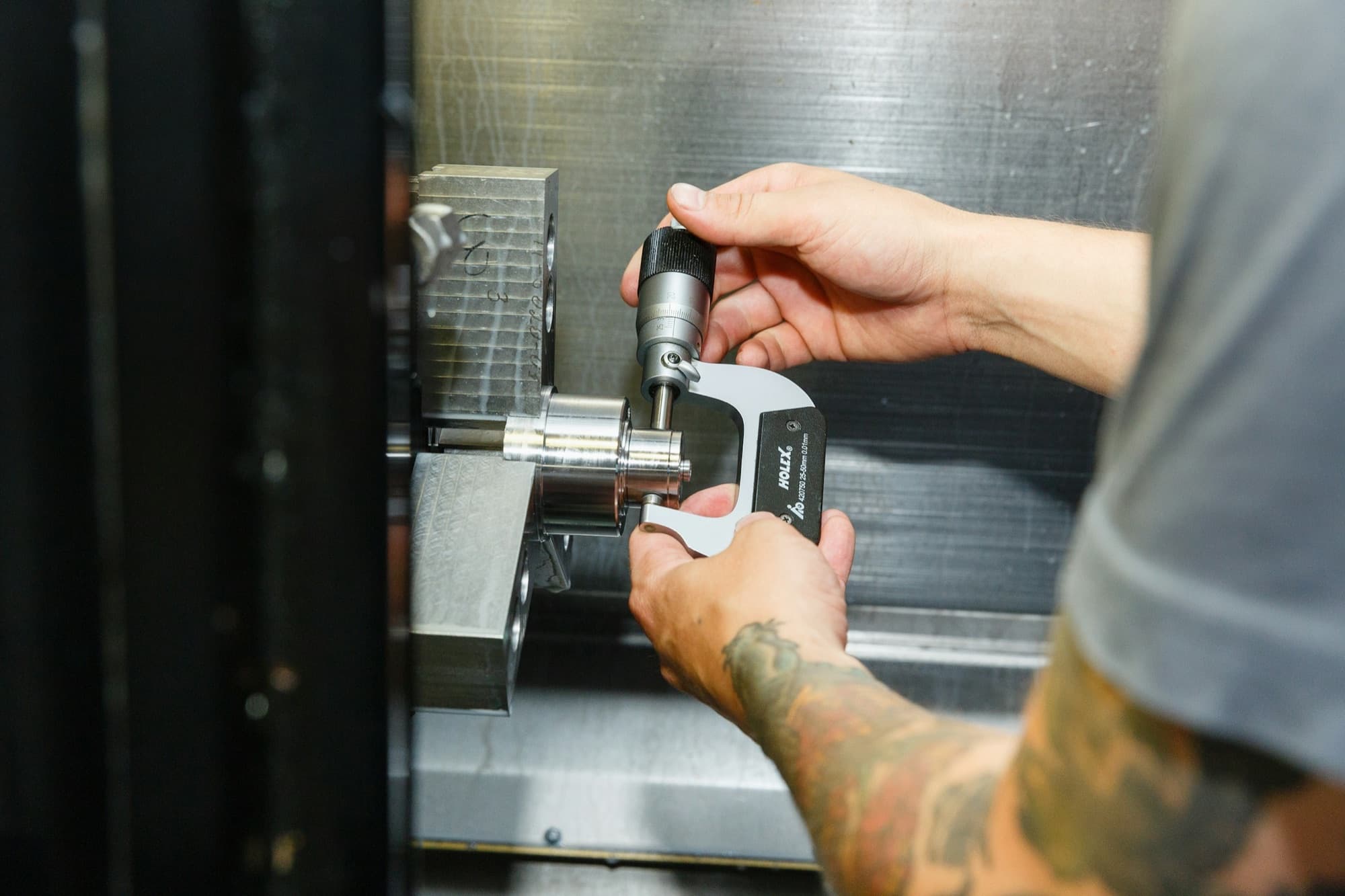
How are principals qualified?
Before a principal sees an RFQ, it has to fit the part on five counts.
- Process capability
- The right equipment for the part, such as press tonnage and bed size, shot size, machine envelope or bar capacity, and a record of holding the tolerances the drawing calls out.
- Quality system
- A certified quality management system when the program requires one. When it doesn't, a documented one: calibrated gauges, controlled drawings, inspection records.
- Documentation
- The paperwork the program needs, done in-house: first article reports, PPAP submissions, material certs and certificates of conformance.
- Capacity and region
- Room in the schedule at the quoted volume, and a location that works for freight, lead time and any domestic-content rule on the program.
- History
- How the principal has done on earlier programs: delivery, first-pass approvals, and how problems were handled.
Which certifications does a program need?
Principals hold these, not SSG. An RFQ goes only to principals holding what the program requires.
StandardWhat it coversTypical for
- ISO 9001
- Quality management: document control, corrective action, supplier control, continual improvement.
- The baseline most OEMs expect from production suppliers.
- IATF 16949
- ISO 9001 plus automotive requirements and the core tools: APQP, PPAP, FMEA, MSA and SPC.
- Automotive production and service parts, Tier 1 and Tier 2.
- AS9100
- ISO 9001 plus configuration management, product safety, counterfeit part prevention and first article to AS9102.
- Aviation, space and defense supply chains.
- ISO 13485
- Quality management for medical devices: design controls, risk management, process validation and traceability.
- Medical device components and assemblies.
- ITAR registration
- Not a quality standard. Registration with the State Department's DDTC to make or export defense articles.
- Parts on the US Munitions List. US principals only.
A certificate covers named sites and a scope. Check that it names the plant making your part and a scope that includes the process, then check the expiry date.
What is first article inspection?
The full check of the first production parts against every requirement on the drawing, before production is released.
Results are recorded against a ballooned drawing: every dimension, note and specification gets a number, a requirement and a measured value. In aerospace the report follows AS9102 and has three forms.
- Form 1Part number accountabilityThe part, its revision, and any subassemblies or detail parts.
- Form 2Product accountabilityRaw material, special processes such as heat treat and plating, and functional tests, each with its cert.
- Form 3Characteristic accountabilityEvery ballooned characteristic, with the requirement and the measured result.
When is a new first article needed?
- A new part, or a drawing revision that affects form, fit or function.
- A change of plant, process, tooling or special-process source.
- A two-year lapse in production, under AS9102.
- A first article that failed, after the fix.
Glossary: first article inspection
What are the PPAP levels?
PPAP is the AIAG Production Part Approval Process. The level sets what the supplier submits to the customer; everything else is kept at the plant and made available on request.
| Level | Submitted to the customer |
|---|---|
| 1 | Part Submission Warrant (PSW) only, plus an appearance approval report for parts with appearance requirements. |
| 2 | PSW with product samples and limited supporting data. |
| 3 | PSW with product samples and complete supporting data. The default level. |
| 4 | PSW and other requirements as defined by the customer. |
| 5 | PSW with product samples and complete supporting data, reviewed at the supplier's manufacturing location. |
Level 3 is the default unless the customer says otherwise. A new submission is due for a new part, an engineering change, a new material or subsupplier, tooling that is moved or replaced, and production restarting after 12 months or more.
Which of the 18 elements are submitted at each level?
Submission level
Level 3:
- 01Design recordsSubmitted
- 02Authorized engineering change documentsSubmitted
- 03Customer engineering approvalSubmitted
- 04Design FMEASubmitted
- 05Process flow diagramSubmitted
- 06Process FMEASubmitted
- 07Control planSubmitted
- 08Measurement system analysis studiesSubmitted
- 09Dimensional resultsSubmitted
- 10Material and performance test resultsSubmitted
- 11Initial process studiesSubmitted
- 12Qualified laboratory documentationSubmitted
- 13Appearance approval reportSubmitted
- 14Sample production partsSubmitted
- 15Master sampleKept at the plant
- 16Checking aidsKept at the plant
- 17Customer-specific requirementsSubmitted
- 18Part Submission Warrant (PSW)Submitted
Submitted to the customer Kept at the plant, available on request As the customer definesAfter the AIAG PPAP manual, 4th edition.
What inspection can I pick in the builder?
Three levels. The estimate prices the documentation as a one-time charge, so the number you see includes it.
- StandardFinal inspection to the drawing, and a certificate of conformance (C of C) with each shipment.Included in the estimate
- FAIA first article report in AS9102 format, approved before production ships.Adds a one-time documentation charge
- PPAPA Level 3 submission: warrant, samples and complete supporting data.Adds a one-time charge and about 1–2 weeks to the first shipment
What paperwork comes with the parts?
What ships with a lot depends on the purchase order. Put the requirement on the RFQ so it is in the quote.
- Certificate of conformance
- The principal's signed statement that the lot meets the drawing and the purchase order.
- Material certs
- Mill test reports for metals, often to EN 10204 type 3.1, and certificates of analysis for resins and rubber compounds, tied to heat or lot numbers.
- Process certs
- Heat treat, plating and coating certs, such as zinc plating thickness to ASTM B633 or anodize to MIL-A-8625.
- Inspection reports
- Dimensional results for first article or PPAP, and sampling results when the purchase order calls for them.
- Compliance declarations
- RoHS, REACH, conflict minerals and country of origin, when the program needs them.
How does traceability work?
Heat and lot numbers follow the material from the mill cert to the shipment, so a problem in the field traces back to the lot, the material and the process that made it. If parts need lot marking, serialization or records kept longer than the principal's standard retention, say so on the RFQ.
What happens when a part is wrong?
The principal owns the fix. Your rep issues or relays the corrective action request, keeps the timeline, and stays on it until it closes.
- 1
Contain
Stop the flow. Quarantine suspect stock at the plant, in transit and on your floor, then sort or replace so your line keeps running.
- 2
Find the root cause
The principal investigates with 8D, 5 Whys or a fishbone diagram, and proves the cause before fixing it.
- 3
Correct and prevent
A permanent fix in the process, the tool or the control plan, with the PFMEA and work instructions updated to match.
- 4
Verify and close
Evidence the fix works, such as measured parts from later lots, before the corrective action request closes.
The formal request is usually a SCAR (supplier corrective action request), answered in an 8D report: team, problem description, containment, root cause, corrective action, validation, prevention and closure.
Questions buyers ask about quality
Does SSG hold ISO 9001 certification?
No. SSG is a manufacturers' representation firm, not a plant, so it holds no manufacturing certifications. It matches each program with principals that hold the certification the program requires, and you can ask for the principal's certificate before you place the order.
What PPAP level should I ask for?
Level 3 is the default under the AIAG manual and what most automotive customers expect. Level 1 or 2 fits low-risk parts and minor changes. Level 4 covers customer-defined requirements, and Level 5 adds a review of the data at the supplier's plant.
Is first article inspection the same as PPAP?
No. A first article checks the first production parts against every drawing requirement. PPAP goes further: it proves the production process with capability studies, FMEAs, a control plan and a signed warrant, and it includes dimensional results like a first article does.
Can I audit the plant that makes my parts?
Usually, yes. Ask through your rep, who arranges the visit with the principal. The principal sets the dates and may ask for an NDA first.
Who pays for first article and PPAP?
The buyer, usually as a one-time charge on the quote, because the documentation takes engineering and inspection time. The part builder adds it to the estimate when you pick FAI or PPAP.
Can offshore principals meet these requirements?
Many can. Offshore plants that supply automotive or medical customers often hold IATF 16949 or ISO 13485 and submit PPAP. State the requirement on the RFQ so only principals that meet it quote. ITAR work stays with registered US principals.
Put the requirement on the RFQ.
Pick FAI or PPAP in the builder, or list certifications and inspection in the quote form. Only principals that meet it will quote.