Loading page
Core line, represented 25+ years
CNC turning
CNC turning spins bar or a chucked blank while a stationary cutting tool moves along and across it, producing diameters, faces, tapers, grooves, bores and threads. It holds ±0.001 in (±0.025 mm) on diameters, needs no hard tooling, and suits round parts from about 0.25 in to 12 in (6–300 mm) in quantities of 10 to 10,000.
A method under production machining, turning, and sawing, alongside CNC milling.
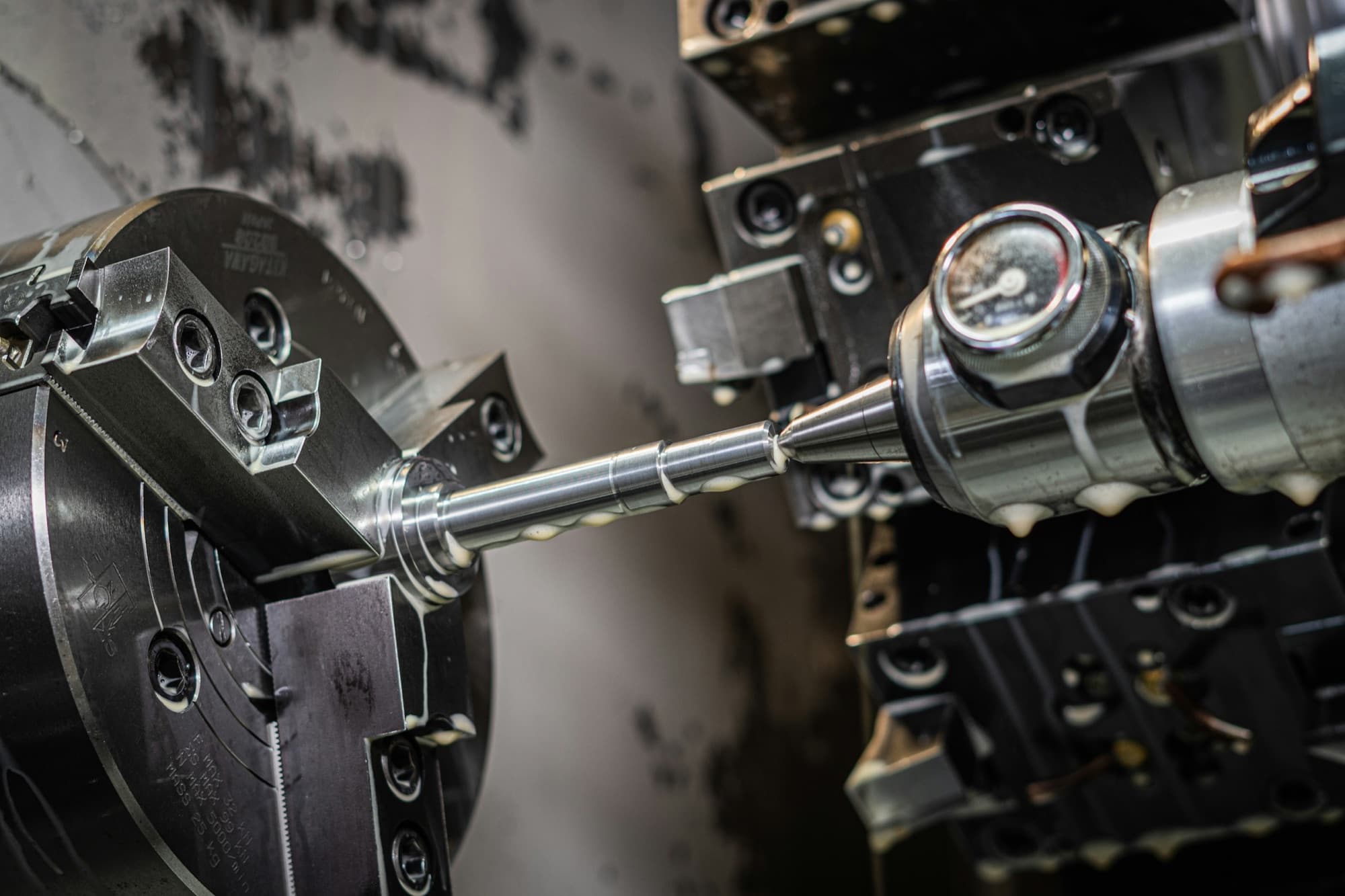
How does CNC turning work?
The schematic plays while it is on screen. Pick a phase to hold it there.
- 1
Load bar or blank
Bar stock feeds through the spindle from a bar feeder, or a sawn blank is clamped in a three-jaw chuck.
- 2
Face the end
The tool moves across the spinning end to make a flat, square datum face.
- 3
Rough and finish the OD
The tool travels along the axis in roughing passes, then a finishing pass holds the diameter and surface finish.
- 4
Groove, bore and thread
Grooving, boring and threading tools index in from the turret for undercuts, IDs and threads.
- 5
Live-tool features
On a mill-turn, powered tools drill cross holes and mill flats while the spindle holds position.
- 6
Part off
A parting blade cuts the finished part from the bar, and the bar feeds forward for the next one.
What can CNC turning hold?
Typical ranges across principals. Your drawing, material and quantity set the real numbers in the quote.
| Diameter tolerance | ±0.001 in (±0.025 mm) standard; ±0.0005 in (±0.013 mm) critical |
|---|---|
| Concentricity | 0.001 in (0.025 mm) TIR in one chucking |
| Bar-fed capacity | Up to about 2.5–3.5 in (65–90 mm) diameter |
| Chucked parts | Up to about 12–20 in (300–500 mm) diameter |
| As-turned finish | 32–63 µin Ra (0.8–1.6 µm) |
| Economic volume | 10–10,000 parts per order |
| Lead time | 1–3 weeks typical |
When is CNC turning the right call?
Best for
- Shafts, pins, bushings, spacers, fittings and flanges
- Diameters over about 1.25 in (32 mm), beyond most Swiss machines
- Concentric features held to 0.001 in (0.025 mm) TIR in one chucking
- Mill-turn parts with flats, cross holes and slots done on live tooling
Pick something else when
- Long, slender parts under 1.25 in diameter: Swiss turning supports the cut at the guide bushing
- Simple turned parts over 50,000 a year: cam or CNC multi-spindle screw machines cost less per part
- Mostly prismatic parts with a round feature: CNC milling
How does CNC turning compare with the alternatives?
Typical values. Pick an alternative to see where each one wins.
CNC turning compared with
CNC turningSwiss turning
- Precisionlooser → tighter
- Volume it pays atone-offs → millions
- Upfront toolingnone → heavy
- Shape freedomnarrow → wide
CNC turning · pick it when
Round parts over about 1.25 in (32 mm) diameter, or short parts with low length-to-diameter ratio.
Swiss turning · pick it when
Small, long, slender turned parts under 1.25 in (32 mm) diameter with milled or cross-drilled features.
About swiss turningMethodTypical toleranceEconomic volumeToolingLead time
- CNC turningthis pageTypical tolerance±0.001 in (±0.025 mm) on diametersEconomic volume10–10,000 parts per orderToolingNone; standard inserts and jawsLead time1–3 weeks
- Typical tolerance±0.0002–0.0005 in (±0.005–0.013 mm) on diametersEconomic volume1,000–1,000,000 partsToolingNone; setup 4–8 hoursLead time2–5 weeks
- Typical tolerance±0.001–0.002 in (±0.025–0.05 mm)Economic volume50,000 parts and upToolingCams and form tools $1,000–$5,000Lead time3–6 weeks
- Typical tolerance±0.005 in (±0.13 mm); ±0.001 in (±0.025 mm) on critical featuresEconomic volume1–5,000 parts per orderToolingNone; soft jaws or fixtures $200–$3,000Lead time1–3 weeks
Which design rules keep CNC turning affordable?
Rules of thumb principals apply at DFM review. Each one has a reason.
RuleTargetWhy
- Length-to-diameter ratio
- ≤ 3:1 unsupported
- Longer parts deflect away from the tool. Past 3:1 add tailstock support or go Swiss.
- Groove and undercut width
- ≥ 0.062 in (1.6 mm)
- Standard grooving inserts start near this width. Narrower needs special tools.
- Internal corner radius
- Match the insert: 0.008–0.031 in (0.2–0.8 mm)
- A sharp internal corner forces a small nose radius, which cuts slower and wears faster.
- Thread relief
- 1–2 thread pitches
- A relief groove lets the threading tool run out cleanly and the mating part seat fully.
- Bore depth
- ≤ 4× bore diameter
- Boring bars chatter at long overhangs, which costs finish and time.
What drives the cost of CNC turning?
In order of impact.
- 1
Cycle time
Material removed and the number of tool changes. Turning is usually faster than milling for the same round part.
- 2
Material and bar size
Bar is bought by the foot at the next standard size over the largest diameter. Free-machining grades such as 12L14 and C360 cut fastest.
- 3
Secondary operations
Cross holes and flats need live tooling or a second machine. Mill-turn does both in one setup.
- 4
Setup
1–3 hours per job, spread over the order quantity.
- 5
Tolerance and finish
Ground-level tolerances under ±0.0002 in (±0.005 mm) need centerless or cylindrical grinding after turning.
Budgetary estimate for a stepped shaft turned from bar, from the same estimator as the part builder. Change a size, the quantity or the material and the price updates.
Turned shaft · CNC machining
Order total $3,626
- Tooling
- None
- no hard tooling
- Piece price
- $12.40
- before setup + tooling
- Lead time
- 1–3 weeks
- to first production
Size
Drag a row to adjust · click to type
Major diameter16.016.0 mm
Overall length60.060.0 mm
Step diameter10.010.0 mm
Quantity
Price per part falls as volume rises
Exact quantity250250 pcs
Material
Design checks pass
Open in builderBudgetary estimate for a representative part. Firm quotes come from principals after drawing review.
CNC turning questions
What is the difference between CNC turning and CNC milling?
In turning, the part spins and the tool stays still, so it makes round features. In milling, the tool spins and the part stays still, so it makes flats, pockets and hole patterns. Mill-turn machines combine both in one setup.
What tolerance can CNC turning hold?
±0.001 in (±0.025 mm) on diameters is standard, with ±0.0005 in (±0.013 mm) on critical diameters. Tighter than ±0.0002 in (±0.005 mm) usually calls for grinding after turning.
When should a turned part move to Swiss or a screw machine?
Move to Swiss when the part is under about 1.25 in (32 mm) diameter and long or slender, or needs many milled features. Move to a multi-spindle screw machine when a simple turned part runs over roughly 50,000 a year.
What materials turn best?
Free-machining grades: 12L14 and 1215 steel, 303 stainless, C360 brass and 6061 or 2011 aluminum. Harder alloys such as 4140, 17-4 PH and titanium turn well but slower.
Can a turned part have flats and cross holes?
Yes. Mill-turn lathes with live tooling drill, tap and mill flats while the part is still in the chuck, so the features stay true to the turned diameters.
Quote CNC turning with a rep.
Send a STEP file and drawing. A rep routes the RFQ to principals that run this method every day, and brings back firm quotes.