Loading page
Core line, represented 25+ years
CNC milling
CNC milling cuts a part from a clamped block with rotating end mills, drills and taps that move under computer control along three to five axes. It holds ±0.005 in (±0.13 mm) as standard and ±0.001 in (±0.025 mm) on critical features, needs no hard tooling, and fits quantities from one prototype to a few thousand production parts.
A method under production machining, turning, and sawing, alongside CNC turning.
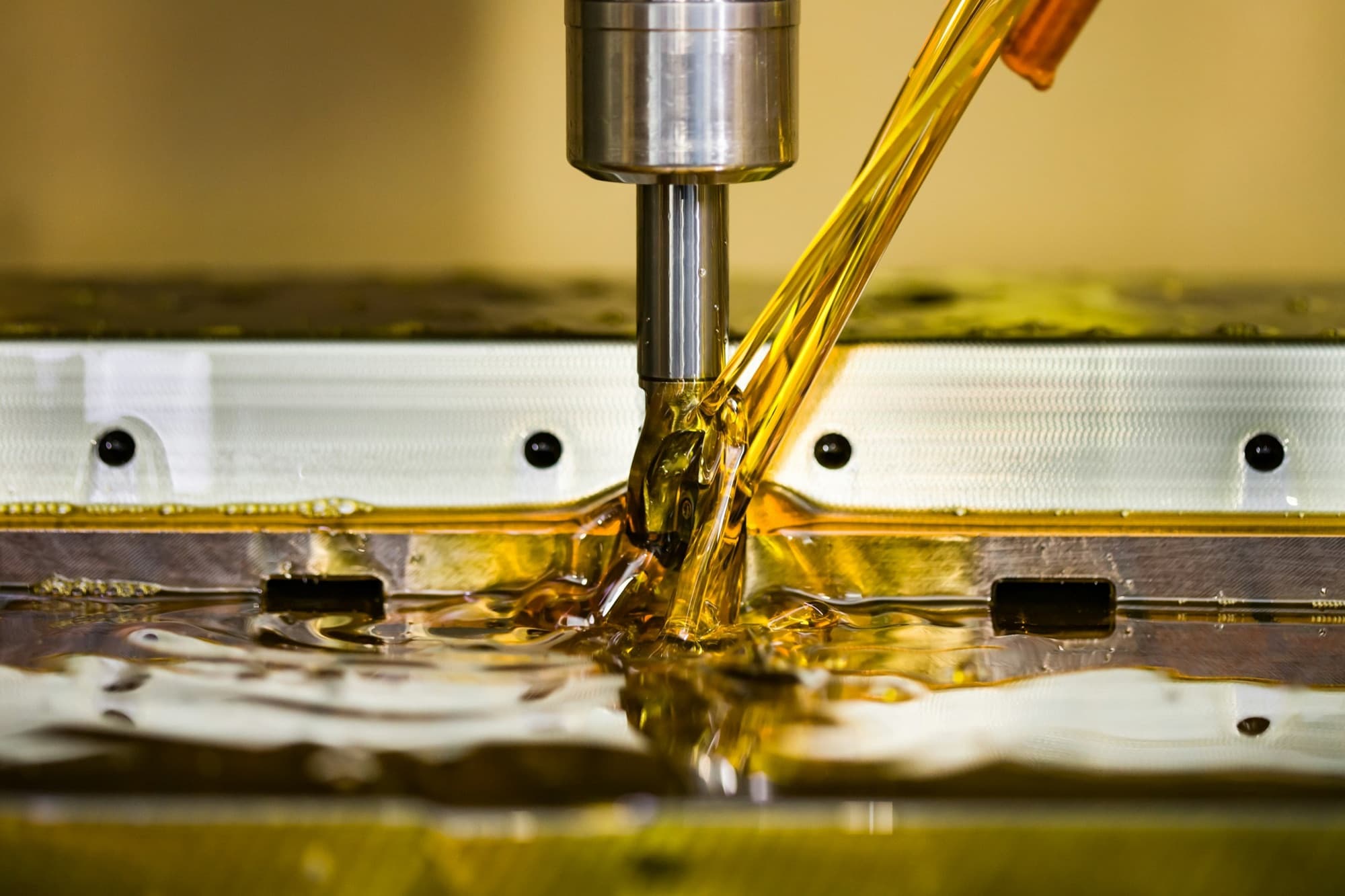
How does CNC milling work?
The schematic plays while it is on screen. Pick a phase to hold it there.
- 1
Program the toolpath
A programmer turns the 3D model into CAM toolpaths: which tools, what order, spindle speeds, feed rates and step-downs for each feature.
- 2
Fixture the stock
Saw-cut bar or plate is clamped in a vise, on soft jaws machined to fit, or on a dedicated fixture for production runs.
- 3
Face and rough
A face mill squares the top, then larger end mills clear most of the material quickly, leaving 0.010–0.020 in (0.25–0.5 mm) for finishing.
- 4
Finish walls and floors
Smaller tools make light finishing passes to hold size and surface finish on walls, floors and bores.
- 5
Drill, tap and chamfer
Holes are spotted, drilled, reamed or tapped, and edges chamfered, often in the same setup.
- 6
Flip and inspect
The part is turned over for the back side if needed, deburred, and checked against the drawing with gauges or a CMM.
What can CNC milling hold?
Typical ranges across principals. Your drawing, material and quantity set the real numbers in the quote.
| Standard tolerance | ±0.005 in (±0.13 mm), or ISO 2768-m |
|---|---|
| Precision tolerance | ±0.0005–0.001 in (±0.013–0.025 mm) on critical features |
| Typical 3-axis envelope | Up to about 40 × 20 × 20 in (1,000 × 500 × 500 mm) |
| As-machined finish | 63–125 µin Ra (1.6–3.2 µm); 32 µin (0.8 µm) with finishing passes |
| Minimum wall | About 0.030 in (0.8 mm) metal; 0.060 in (1.5 mm) plastic |
| Economic volume | 1–5,000 parts per order |
| Lead time | 1–3 weeks typical; 3–5 days expedited for simple parts |
When is CNC milling the right call?
Best for
- Prismatic parts: plates, housings, manifolds, brackets and blocks
- 1–5,000 parts per order with no tooling investment
- Tight hole positions, flatness and bores in aluminum, steel, stainless and plastics
- Bridge production while a casting or mold is being built
Pick something else when
- Round parts and shafts: CNC turning or Swiss turning is faster
- Over about 5,000 parts a year of the same shape: die casting, powdered metal or stamping usually wins on unit cost
- Thin sheet parts with bends: laser cutting and press brake forming cost less
How does CNC milling compare with the alternatives?
Typical values. Pick an alternative to see where each one wins.
CNC milling compared with
CNC milling5-axis milling
- Precisionlooser → tighter
- Volume it pays atone-offs → millions
- Upfront toolingnone → heavy
- Shape freedomnarrow → wide
CNC milling · pick it when
Prismatic parts: flats, pockets, bosses and hole patterns on several faces.
5-axis milling · pick it when
Complex parts that would need four or more 3-axis setups, or sculpted surfaces.
MethodTypical toleranceEconomic volumeToolingLead time
- CNC millingthis pageTypical tolerance±0.005 in (±0.13 mm); ±0.001 in (±0.025 mm) on critical featuresEconomic volume1–5,000 parts per orderToolingNone; soft jaws or fixtures $200–$3,000Lead time1–3 weeks
- Typical tolerance±0.001–0.002 in (±0.025–0.05 mm)Economic volume1–1,000 parts per orderToolingNone; one fixtureLead time2–4 weeks
- Typical tolerance±0.001 in (±0.025 mm) on diametersEconomic volume10–10,000 parts per orderToolingNone; standard inserts and jawsLead time1–3 weeks
- Typical tolerance±0.004–0.005 in (±0.10–0.13 mm)Economic volume1–5,000 partsToolingNone; a DXF and a nestLead time3–10 days
Which design rules keep CNC milling affordable?
Rules of thumb principals apply at DFM review. Each one has a reason.
RuleTargetWhy
- Internal corner radius
- ≥ 1/3 of pocket depth
- An end mill leaves its own radius. Bigger radii allow bigger, stiffer tools that cut faster.
- Pocket depth
- ≤ 4× tool diameter
- Long-reach tools deflect and chatter, so deep pockets need slower passes.
- Tapped hole depth
- 1.5× thread diameter
- Thread engagement past 1.5× adds almost no strength and raises the tap breakage risk.
- Setups
- Keep features on 1–2 faces
- Every flip is a new setup with its own handling time and datum transfer error.
- Tolerances
- Tight only where it functions
- Going from ±0.005 in to ±0.001 in can double cycle time and adds inspection.
- Text and logos
- Engraved 0.010–0.020 in deep
- Small engraving tools are slow. Laser marking is cheaper for part numbers.
What drives the cost of CNC milling?
In order of impact.
- 1
Machine time
Cycle time multiplied by the shop rate, typically $60–$120 an hour for 3-axis and $100–$200 an hour for 5-axis in the US.
- 2
Setups
Each setup costs programming, fixturing and first-piece checks. It is spread across the order, so it dominates at 1–25 parts.
- 3
Material
Stock is bought oversize. A part that removes 80% of its block pays for the block, not the part.
- 4
Tolerances and finish
Tight tolerances mean slower finishing passes, more tool changes and CMM inspection time.
- 5
Finishing
Anodize, plating or powder coat adds a few days and a per-part or per-lot charge.
Budgetary estimate for a milled plate with a pocket and holes, from the same estimator as the part builder. Change a size, the quantity or the material and the price updates.
Plate · CNC machining
Order total $2,193
- Tooling
- None
- no hard tooling
- Piece price
- $33.10
- before setup + tooling
- Lead time
- 5–10 days
- to first production
Size
Drag a row to adjust · click to type
Length120120 mm
Width80.080.0 mm
Thickness6.006.00 mm
Quantity
Price per part falls as volume rises
Exact quantity5050 pcs
Material
Design checks pass
Open in builderBudgetary estimate for a representative part. Firm quotes come from principals after drawing review.
CNC milling questions
What tolerance can CNC milling hold?
Standard CNC milling holds ±0.005 in (±0.13 mm) without extra cost. Most principals hold ±0.001 in (±0.025 mm) on critical features, and ±0.0005 in (±0.013 mm) is achievable on bores and fits at added cost for slower passes and inspection.
When is 5-axis milling worth it?
When a part would need four or more setups on a 3-axis machine, or has angled holes and sculpted surfaces. 5-axis time costs more per hour but can finish the part in one or two setups, which cuts handling and improves accuracy between features.
How many parts make CNC milling uneconomic?
It depends on the part, but over about 5,000 parts a year the per-part machine time usually costs more than amortized tooling for die casting, powdered metal, stamping or molding. Many programs start machined and move to a tooled process once the design is stable.
What file do I send for a milled part?
A STEP file for the geometry and a PDF drawing for tolerances, threads, finish and material. The drawing controls anything the model cannot show, such as thread class and surface finish.
Why do internal corners have a radius?
The end mill is round, so it leaves its own radius in every internal vertical corner. Sharp internal corners need EDM or a separate operation. Specify the largest radius the design allows.
Quote CNC milling with a rep.
Send a STEP file and drawing. A rep routes the RFQ to principals that run this method every day, and brings back firm quotes.