Loading page
Should I die cast or machine my part?
Machine from billet below about 1,000 parts a year or while the design is changing: there is no tooling, and critical features hold ±0.001 in (±0.025 mm). Switch to die casting once volume passes roughly 2,500 parts a year and the design is stable: a $10,000–$100,000+ die produces near-net parts that need only light finish machining on bores, threads and sealing faces.
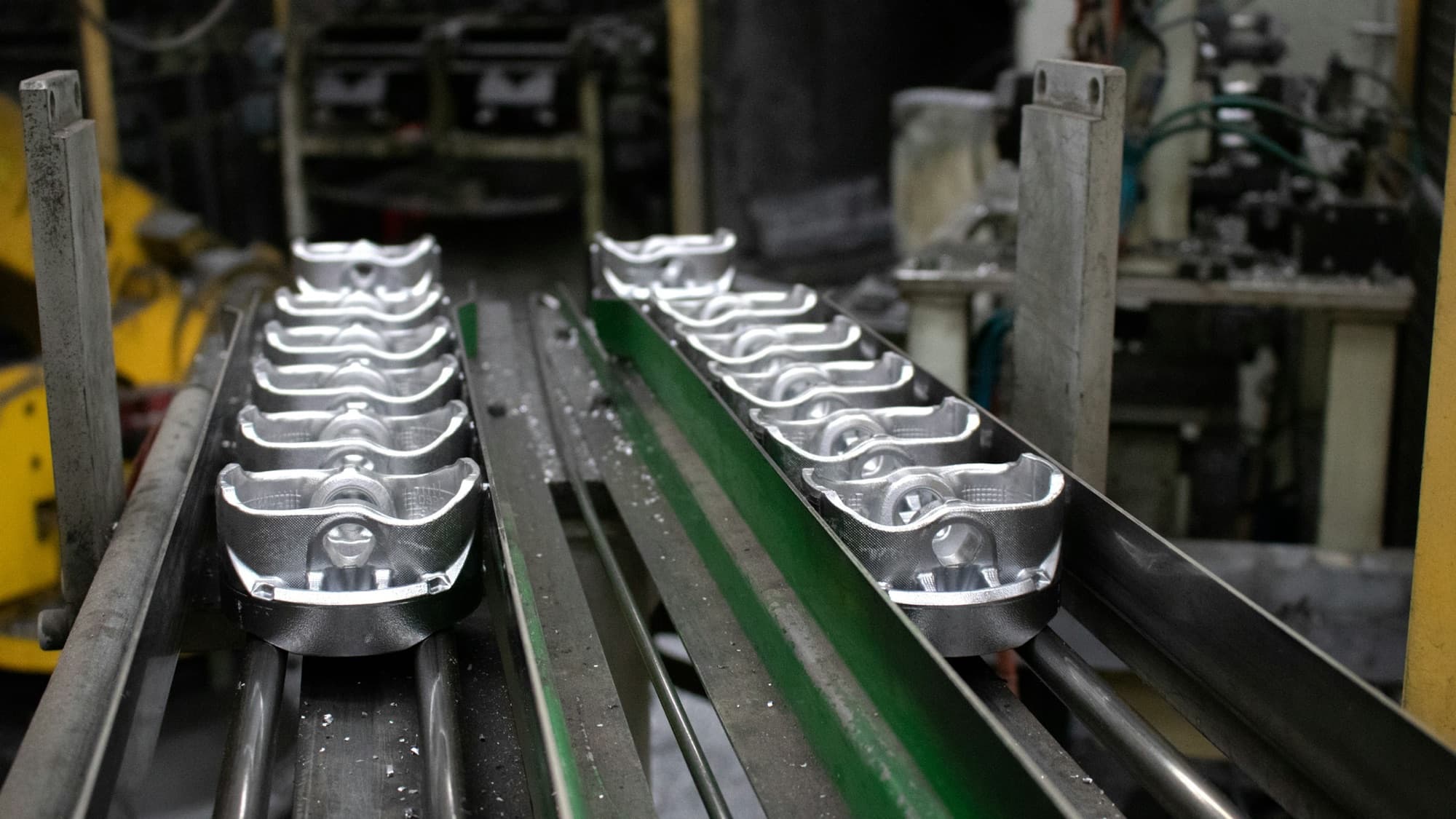
Which is cheaper at your quantity?
The same housing, each process in a suitable material (A380 and A380).
| Quantity | Die casting | CNC machining |
|---|---|---|
| 10 | $2,257 | $179 |
| 50 | $451 | $135 |
| 100 | $227 | $124 |
| 500 | $47.20 | $95.80 |
| 1,000 | $24.80 | $85.80 |
| 5,000 | $6.81 | $79.70 |
| 10,000 | $4.57 | $79.60 |
| 50,000 | $2.35 | $79.60 |
| 100,000 | $1.98 | $79.60 |
Where each pays off
Zinc and aluminum die casting
1101001k10k100k1M+
- Tooling
- 8–14 weeks
- First article
- 1–3 weeks after die tryout
- Production
- 3–6 weeks per release
±0.002–0.010 in (±0.05–0.25 mm) on the first inch, plus about ±0.001 in per added inch (NADCA precision to standard)
Production machining, turning, and sawing
1101001k10k100k1M+
- First article
- 1–3 weeks
- Production
- 2–6 weeks per release
±0.005 in (±0.13 mm), or ISO 2768-m
Which should you pick?
Pick Die casting when
- Annual volume is above about 2,500 parts
- The part is a complex housing with thin walls, ribs and bosses
- Most of a billet would otherwise become chips
- The design is frozen
Pick CNC machining when
- Volume is under about 1,000 parts a year, or the parts are prototypes
- The design is still changing
- Many features need tight tolerances
- The part needs wrought alloy properties: welding, anodize or heat treat
Key differences
| Die casting | CNC machining | |
|---|---|---|
| Tooling | $10,000–$100,000+ die; 8–14 weeks | None; first article in 1–3 weeks |
| Tolerance | ±0.002–0.010 in (±0.05–0.25 mm) on the first inch plus ±0.001 in per inch; critical features machined | ±0.005 in (±0.13 mm) standard; ±0.0005–0.001 in (±0.013–0.025 mm) critical |
| Alloys | A380, A383, Zamak 3 and Zamak 5 | Wrought 6061, 7075, steels, stainless, titanium and plastics |
| Internal quality | Some gas porosity; impregnate for pressure tightness; no welding or heat treat | Fully dense wrought stock |
| Anodize | A380 anodizes gray and blotchy; powder coat instead | 6061 takes clear and dyed anodize |
| Design changes | Die rework costs weeks | Edit the program |
| Draft | About 1–2° on aluminum | None needed |
Questions
At what quantity is die casting cheaper than machining?
Typically somewhere between 1,000 and 2,500 parts a year, depending on die cost and how much material the machined part removes. Complex housings that are mostly chips from billet cross over sooner; simple blocks may never justify a die.
Can I prototype a die cast part by machining it?
Yes, usually from 6061-T6 bar, since A380 is not sold as bar stock. Expect differences: 6061 is more ductile and fully dense, while A380 has about 3.5% elongation and some porosity. Validate strength and leak tests on cast samples.
Do die castings still need machining?
Usually on critical bores, threads and sealing faces. Leave 0.010–0.030 in (0.25–0.75 mm) of stock on machined surfaces, and keep critical dimensions in one die half to reduce machining.
Try both on your part.
The builder prices the same geometry in every suitable process and material, with DFM for each.