Loading page
Network line, now onboarding principals
Laser cutting
Laser cutting melts a narrow kerf through sheet or plate with a focused fiber or CO₂ laser while assist gas blows the molten metal clear. It needs no tooling, cuts any 2D profile from a DXF, and holds about ±0.005 in (±0.13 mm) in steel, stainless and aluminum from 0.020 to about 1 in (0.5–25 mm) thick, with parts usually ready in 3–10 days.
A method under sheet metal fabrication, alongside press brake forming.
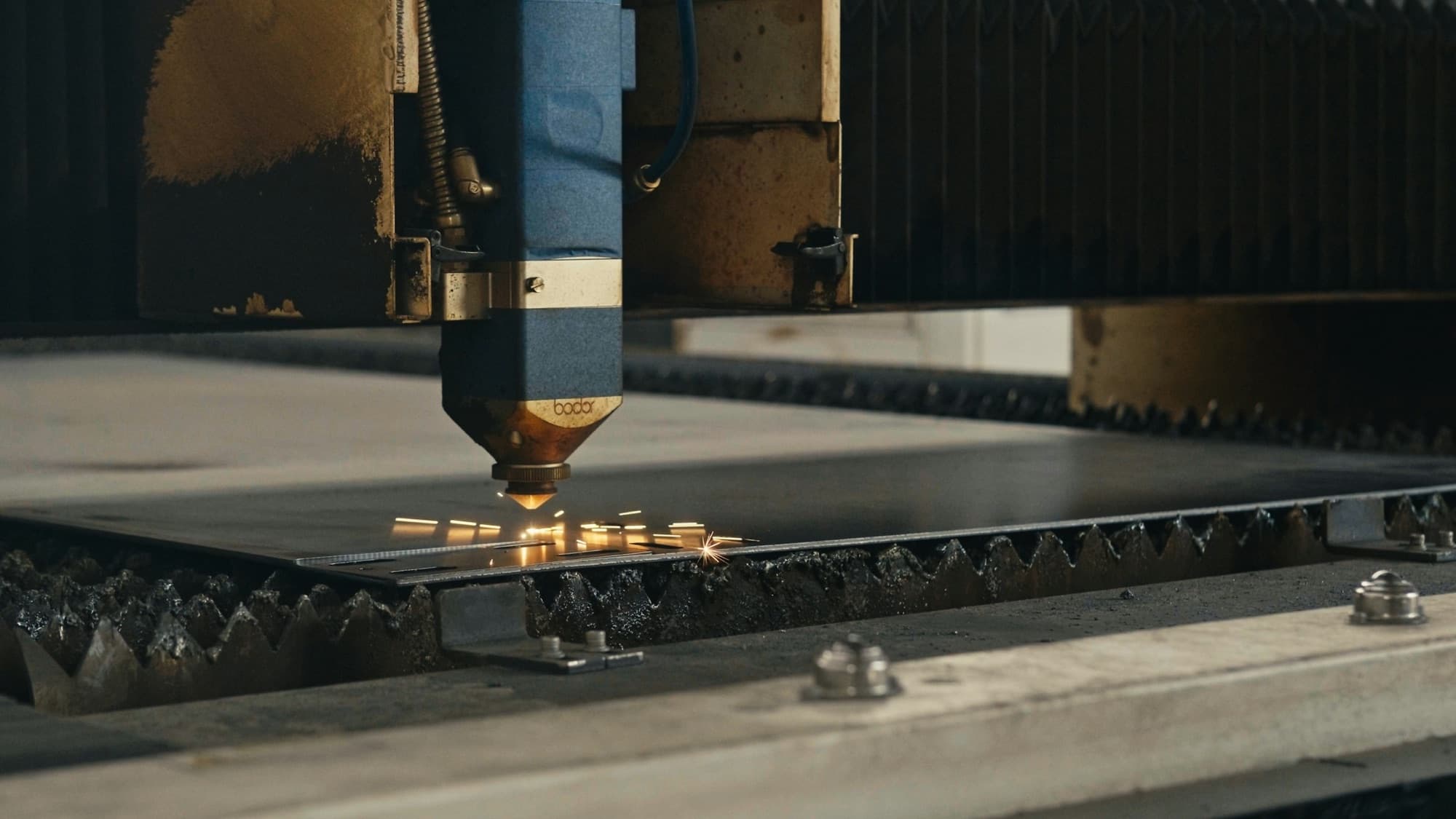
How does laser cutting work?
The schematic plays while it is on screen. Pick a phase to hold it there.
- 1
Nest the parts
CAM software arranges the DXF profiles on a full sheet to use as much material as possible, with lead-ins placed off critical edges.
- 2
Pierce
The beam pierces through the sheet at each start point, just off the finished edge.
- 3
Cut inside features first
Holes and internal cutouts are cut before the outer profile so the part is still held by the sheet while they are cut.
- 4
Cut the outer profile
The head follows the contour at a fixed standoff, with nitrogen for clean oxide-free edges or oxygen for fast cutting of thick mild steel.
- 5
Tab or drop
Parts either fall through the slats or stay held by small micro-tabs until the sheet is unloaded and the parts are knocked out.
- 6
Deburr
A light edge dross or tab witness is removed by a brush deburring machine or by hand before forming or finishing.
What can laser cutting hold?
Typical ranges across principals. Your drawing, material and quantity set the real numbers in the quote.
| Cut tolerance | ±0.004–0.005 in (±0.10–0.13 mm) |
|---|---|
| Kerf width | 0.004–0.012 in (0.1–0.3 mm), thickness dependent |
| Thickness, mild steel | 0.020–1 in (0.5–25 mm) on 6–12 kW fiber |
| Thickness, stainless and aluminum | Up to about 0.75 in (19 mm) typical |
| Sheet size | 60 × 120 in (1.5 × 3.0 m) standard beds |
| Minimum hole | About 1× material thickness |
| Lead time | 3–10 days typical |
When is laser cutting the right call?
Best for
- Flat blanks and profiles in any shape, straight from a DXF
- Prototypes and runs of 1–5,000 parts with no tooling
- Blanks for press brake forming and welded fabrications
- Design changes between orders at no tooling cost
Pick something else when
- Over about 25,000 identical blanks a year: a blanking or progressive die costs less per part
- Thick plate over 1 in (25 mm), or heat-sensitive materials: waterjet
- Formed features such as louvers, embosses and extruded holes: turret punching or stamping
How does laser cutting compare with the alternatives?
Typical values. Pick an alternative to see where each one wins.
Laser cutting compared with
Laser cuttingTurret punching
- Precisionlooser → tighter
- Volume it pays atone-offs → millions
- Upfront toolingnone → heavy
- Shape freedomnarrow → wide
Laser cutting · pick it when
Flat profiles in any shape, prototypes, and short to medium runs of blanks.
Turret punching · pick it when
Many standard holes, louvers, embosses and extruded holes in sheet up to about 0.25 in (6 mm).
MethodTypical toleranceEconomic volumeToolingLead time
- Laser cuttingthis pageTypical tolerance±0.004–0.005 in (±0.10–0.13 mm)Economic volume1–5,000 partsToolingNone; a DXF and a nestLead time3–10 days
- Typical tolerance±0.004–0.005 in (±0.10–0.13 mm)Economic volume100–20,000 partsToolingStandard punches; specials $300–$2,000Lead time1–2 weeks
- Typical tolerance±0.005–0.010 in (±0.13–0.25 mm)Economic volume1–500 partsToolingNoneLead time3–10 days
- Typical tolerance±0.001–0.005 in (±0.025–0.13 mm) pierced; ±0.005–0.010 in across formsEconomic volume25,000 parts a year and upTooling$20,000–$150,000+Lead time8–16 weeks for the die
Which design rules keep laser cutting affordable?
Rules of thumb principals apply at DFM review. Each one has a reason.
RuleTargetWhy
- Minimum hole diameter
- ≥ 1× thickness
- Smaller holes can be cut but taper and may not be round in thicker sheet.
- Web between cuts
- ≥ 1× thickness
- Narrow webs warp from heat and can burn away.
- Hole to bend
- ≥ 2.5× thickness + bend radius
- Holes closer than this distort when the part is formed.
- Inside corners
- Radius ≥ 0.5× thickness
- A small radius avoids a stress riser and heat buildup at the corner.
- Tolerances
- ±0.005 in (±0.13 mm) or looser
- Tighter tolerances on cut edges need machining after cutting.
- File
- 1:1 DXF, closed contours
- Open or doubled lines slow nesting and cause re-quotes.
What drives the cost of laser cutting?
In order of impact.
- 1
Cut length and pierces
Time on the machine is mostly total cut length, plus a fixed time per pierce. Many small holes add up.
- 2
Material and thickness
Thicker material cuts slower. Cut speed drops sharply above about 0.25 in (6 mm).
- 3
Nest yield
Sheet is bought whole. Parts that nest tightly waste less; odd shapes and grain direction rules waste more.
- 4
Assist gas
Nitrogen gives clean, weld-ready edges but uses much more gas than oxygen cutting.
- 5
Deburr and handling
Micro-tab removal and edge finishing are labor per part.
Budgetary estimate for a laser-cut flat plate, from the same estimator as the part builder. Change a size, the quantity or the material and the price updates.
Plate · Sheet metal
Order total $470
- Tooling
- None
- no hard tooling
- Piece price
- $3.75
- before setup + tooling
- Lead time
- 5–12 days
- to first production
Size
Drag a row to adjust · click to type
Length120120 mm
Width80.080.0 mm
Thickness6.006.00 mm
Quantity
Price per part falls as volume rises
Exact quantity100100 pcs
Material
Design checks pass
Open in builderBudgetary estimate for a representative part. Firm quotes come from principals after drawing review.
Laser cutting questions
How accurate is laser cutting?
About ±0.004–0.005 in (±0.10–0.13 mm) on cut features in sheet under 0.25 in (6 mm). Thick plate cuts with a slight edge taper, so tolerances open up to ±0.010 in (±0.25 mm).
Fiber or CO₂ laser?
Fiber lasers now do most sheet metal work. They cut thin steel, stainless, aluminum, brass and copper faster and use less power. CO₂ lasers still suit some thick plate and non-metals such as acrylic and wood.
When does a stamping die beat laser cutting?
Usually somewhere between 5,000 and 25,000 identical blanks a year, depending on the part. A blanking or progressive die costs $5,000–$150,000 but makes a part every press stroke.
Does laser cutting leave a heat-affected zone?
Yes, but it is narrow, typically 0.004–0.020 in (0.1–0.5 mm). It matters for some hardened or heat-treated materials; waterjet leaves none.
What file format do I send?
A 1:1 DXF with closed contours for the flat pattern, plus a STEP of the formed part if it will be bent. Note the material, thickness and grain direction on the drawing.
Quote laser cutting with a rep.
Send a STEP file and drawing. A rep routes the RFQ to principals that run this method every day, and brings back firm quotes.