Short-run metal stamping vs progressive dies: break-even
SSG MFG engineering5 min readStamping
When is short-run stamping cheaper than progressive die stamping?
Short-run stamping uses low-cost single-station or modular tooling to make parts in quantities from about 100 to 50,000 per year. It usually beats a progressive die when total program volume falls below break-even, often somewhere between 25,000 and 100,000 parts, or when the design may still change. Above break-even, a progressive die's lower piece price repays its tooling.

What is short-run metal stamping?
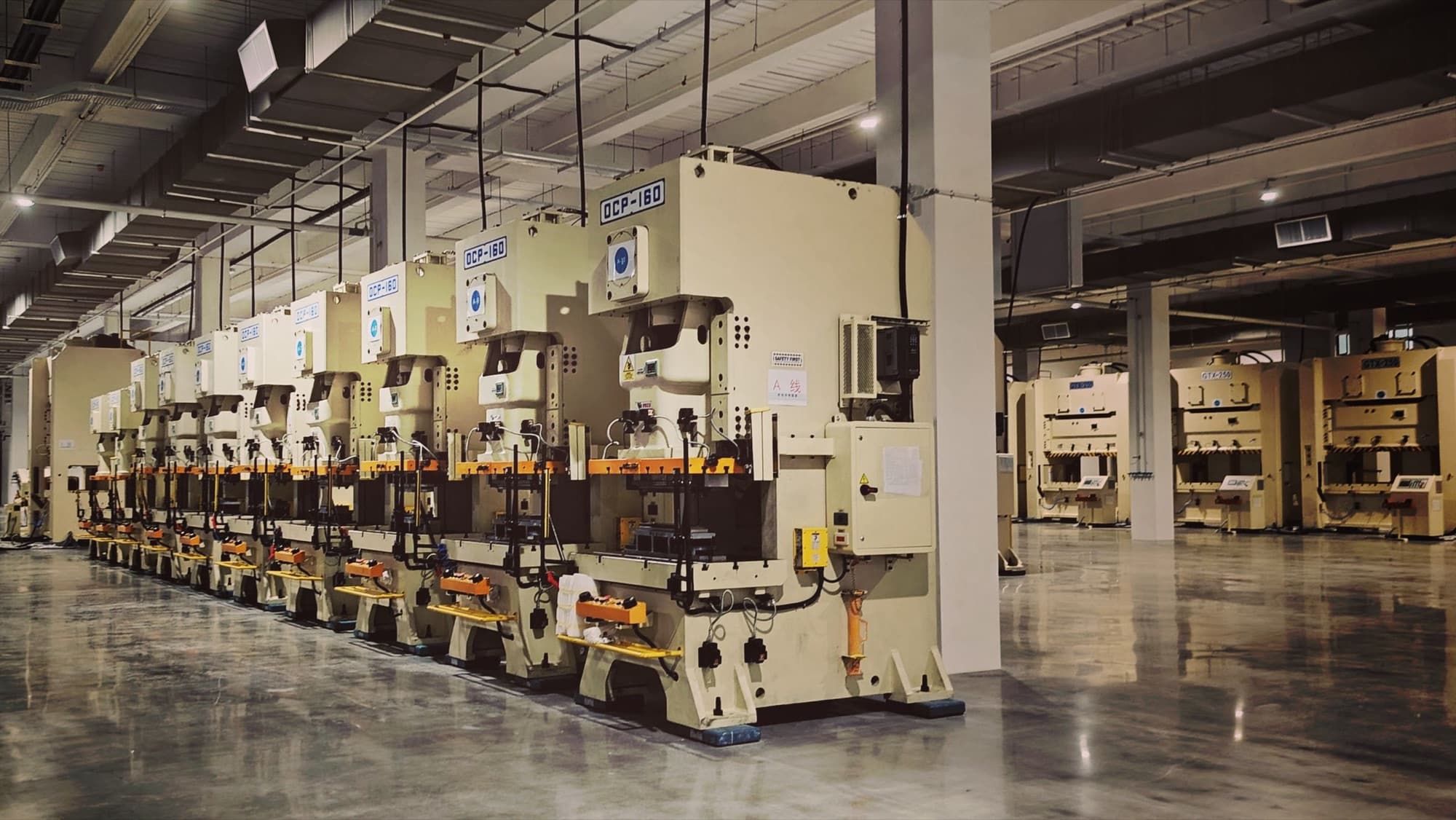
Short-run stamping makes flat and formed sheet metal parts with simple tooling: single-station blanking and piercing dies, forming dies, compound dies, or modular die sets built from standard components. Each operation runs as its own press setup, and an operator loads parts by hand. Some short-run work skips hard blanking tools and cuts blanks on a laser or turret punch before forming.
The trade is simple. Tooling costs less and arrives sooner, but each part is handled several times, so the piece price is higher than in a progressive die, where coil feeds through every station and a finished part drops off each stroke.
How do short-run and progressive tooling compare?
| Factor | Short-run tooling | Progressive die |
|---|---|---|
| Tooling cost | $1,500–$20,000 | $20,000–$150,000+ |
| Tooling lead time | 1–4 weeks | 6–14 weeks |
| Feed | Blanks or strips loaded by hand | Coil fed automatically |
| Output | Hundreds of hits per hour per operation | Thousands of parts per hour |
| Economic volume | About 100 to 50,000 per year | About 25,000 to millions per year |
| Design changes | Change or add one simple die | Rework stations or build a new die |
| Feature-to-feature tolerance | Stacks up across separate setups | Features located in one die, typically tighter |
How do you calculate the break-even volume for stamping tooling?
Break-even is the quantity where total cost is equal for both approaches: Q = (progressive tooling − short-run tooling) ÷ (short-run piece price − progressive piece price). Use program-life volume, not one year, and include per-lot setup charges in the short-run piece price.
| Total quantity | Short-run total cost | Progressive total cost |
|---|---|---|
| 5,000 | $11,500 | $46,750 |
| 25,000 | $33,500 | $53,750 |
| 50,000 | $61,000 | $62,500 |
| 100,000 | $116,000 | $80,000 |
| 250,000 | $281,000 | $132,500 |
In this example, break-even is ($45,000 − $6,000) ÷ ($1.10 − $0.35) = 52,000 parts. A program running 20,000 parts a year for five years clears that easily and belongs in a progressive die. A program at 5,000 a year with a likely redesign does not.
What drives short-run stamping cost?
- Number of operations: every blank, pierce, and form is a separate setup and handling step.
- Lot size: setups are charged per run, so larger releases lower the piece price.
- Material: minimum sheet or coil buys, alloy, and thickness.
- Tolerance: tight feature-to-feature dimensions across operations may need extra fixturing or inspection.
- Secondary work: tapping, hardware insertion, deburring, heat treating, plating, or painting.
What design rules apply to short-run stampings?
- Hole diameter at least 1× material thickness (t), and 1.5× t in stainless and high-strength steel.
- Hole-to-edge distance at least 1.5× t, with 2× t preferred.
- Hole-to-bend distance at least 2.5× t plus the inside bend radius, so the hole does not distort.
- Inside bend radius at least 1× t in mild steel; larger in stainless, high-strength steel, and hard aluminum tempers such as 6061-T6.
- Minimum flange length of about 4× t so the part forms cleanly.
- Bend relief at least 1× t wide where a bend meets an edge.
Typical tolerances are ±0.005 in (±0.13 mm) on formed dimensions, ±0.002–0.003 in (±0.05–0.08 mm) between holes pierced in the same hit, and ±1° on bends. Expect burrs up to about 10% of material thickness, and note burr direction on the drawing if it matters.
When should you move from short-run tooling to a progressive die?
- The design is frozen and has been through at least one production build.
- Program volume is clearly above break-even.
- Feature-to-feature tolerances are tighter than separate setups can hold consistently.
- Handling cost or lead time on repeated setups is limiting supply.
Many programs move in stages: laser-cut and press-brake prototypes, short-run tooling for launch, then a progressive die once demand is proven. Planning for that path early, with consistent datums and features that work in both tool types, keeps the transition from forcing a drawing change.
How do you get a stamping quoted as short run or progressive?
Upload a STEP file or configure the part in the SSG builder at /build for an instant budgetary estimate and a DFM check on hole sizes, bend radii, and edge distances. Include annual volume and expected program life. An SSG rep then routes the RFQ to stamping principals matched to the part and volume, and can request both short-run and progressive quotes so the break-even runs on real numbers.