Loading page
Core line, represented 25+ years
Progressive die stamping
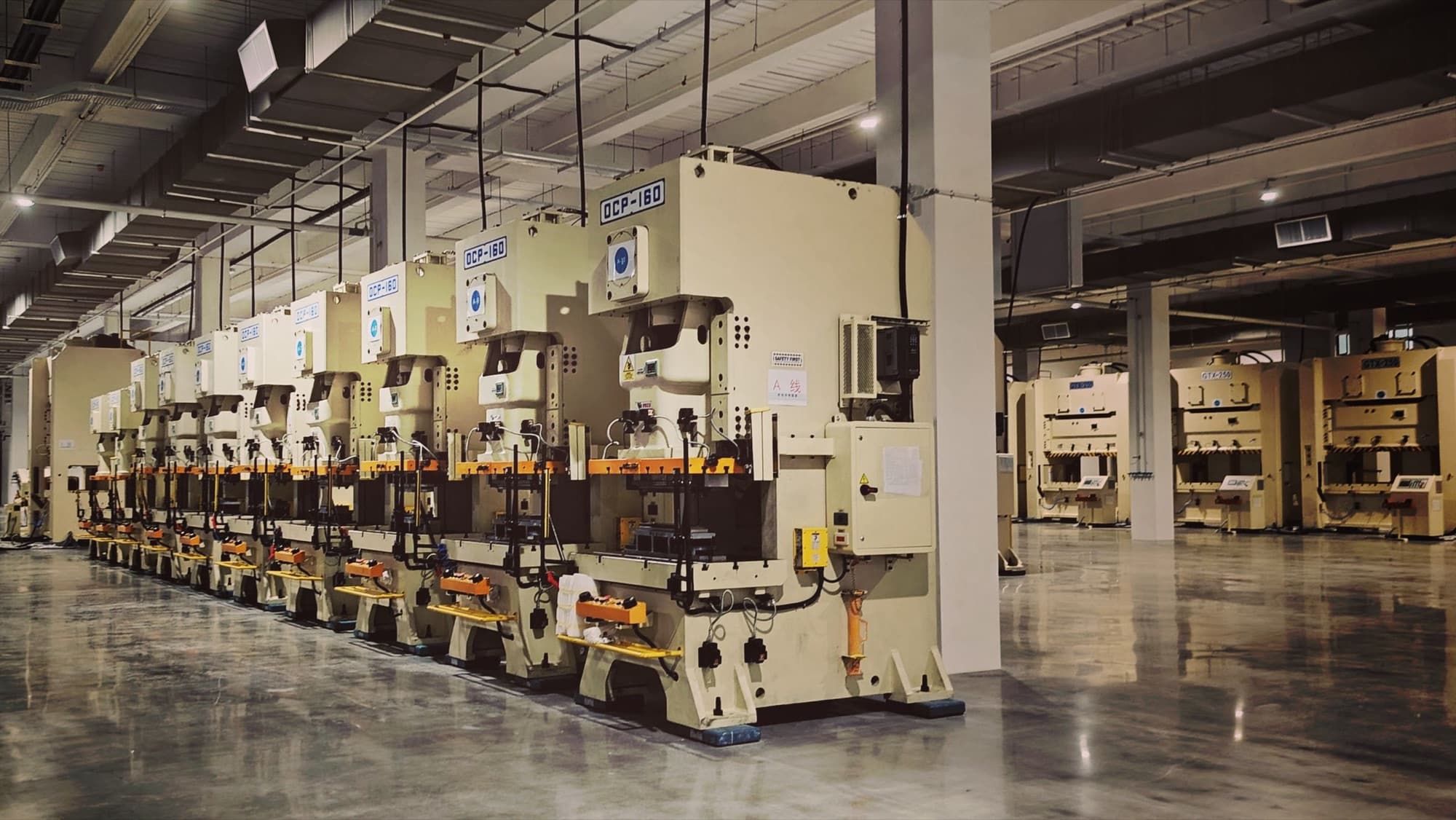
Progressive die stamping feeds coil strip through a single die with a row of stations. Each press stroke pierces, notches, forms and cuts at every station at once, then the strip advances one pitch, so a finished part drops every stroke. Dies typically cost $20,000–$150,000 and run 30–1,000+ strokes a minute, which makes it the lowest-cost method above about 25,000 parts a year.
A method under metal stamping.
How does progressive die stamping work?
The schematic plays while it is on screen. Pick a phase to hold it there.
- 1
Design the strip layout
The die designer lays out every operation along the strip: which station pierces, which forms, and how the part stays attached to a carrier.
- 2
Feed the coil
A servo feeder pulls coil through a straightener and advances it exactly one pitch per stroke.
- 3
Pierce pilots
The first station pierces pilot holes. Every later station's pilots enter them to locate the strip to within thousandths.
- 4
Pierce and notch
Following stations punch holes and trim the outline, leaving the part joined to the carrier.
- 5
Form
Forming stations bend flanges, coin features, emboss ribs or draw shallow shapes, a bit at a time to control springback.
- 6
Cut off
The last station separates the finished part from the carrier; it drops down a chute while the scrap skeleton is chopped.
What can progressive die stamping hold?
Typical ranges across principals. Your drawing, material and quantity set the real numbers in the quote.
| Pierced feature tolerance | ±0.001–0.005 in (±0.025–0.13 mm) |
|---|---|
| Across forms | ±0.005–0.010 in (±0.13–0.25 mm) |
| Material thickness | 0.005–0.250 in (0.13–6.4 mm) |
| Stations | 3–20+ per die |
| Press speed | 30–1,000+ strokes per minute, part size dependent |
| Tooling cost | $20,000–$150,000+ |
| Die build | 8–16 weeks, plus 1–2 weeks tryout |
| Burr height | Typically ≤ 10% of material thickness |
When is progressive die stamping the right call?
Best for
- Brackets, clips, terminals, contacts, shields and washers
- Annual volumes from about 25,000 to millions
- Holding pierced features within ±0.001–0.005 in (±0.025–0.13 mm) to each other
- Material 0.005–0.250 in (0.13–6.4 mm) thick
Pick something else when
- Low volumes: laser cutting and press brake forming need no die
- Deep cups and shells: deep drawn stamping or a transfer die
- Large parts that cannot stay on a carrier strip: transfer die stamping
How does progressive die stamping compare with the alternatives?
Typical values. Pick an alternative to see where each one wins.
Progressive die stamping compared with
Progressive die stampingShort-run stamping
- Precisionlooser → tighter
- Volume it pays atone-offs → millions
- Upfront toolingnone → heavy
- Shape freedomnarrow → wide
Progressive die stamping · pick it when
Flat and formed parts at high annual volume, where a part every stroke pays back the die.
Short-run stamping · pick it when
Moderate volumes where a progressive die would not pay back, with one operation per hit.
About short-run stampingMethodTypical toleranceEconomic volumeToolingLead time
- Progressive die stampingthis pageTypical tolerance±0.001–0.005 in (±0.025–0.13 mm) pierced; ±0.005–0.010 in across formsEconomic volume25,000 parts a year and upTooling$20,000–$150,000+Lead time8–16 weeks for the die
- Typical tolerance±0.002–0.005 in (±0.05–0.13 mm)Economic volume1,000–50,000 partsTooling$2,000–$20,000 in single-station diesLead time3–6 weeks
- Typical tolerance±0.002–0.005 in (±0.05–0.13 mm)Economic volume50,000 parts a year and upTooling$75,000–$500,000+Lead time12–20 weeks
- Typical tolerance±0.004–0.005 in (±0.10–0.13 mm)Economic volume1–5,000 partsToolingNone; a DXF and a nestLead time3–10 days
Which design rules keep progressive die affordable?
Rules of thumb principals apply at DFM review. Each one has a reason.
RuleTargetWhy
- Hole diameter
- ≥ 1× thickness (1.5–2× stainless)
- Smaller punches break. Undersized holes need special punch support.
- Hole to edge
- ≥ 1.5× thickness
- Holes closer to an edge bulge the edge when pierced.
- Hole to bend
- ≥ 2× thickness + radius
- Holes close to a bend distort, unless pierced after forming at added die cost.
- Bend radius
- ≥ 1× thickness
- Tighter radii crack the outside of the bend, especially across the grain.
- Burr direction
- Call out the burr side
- The burr is on the die side of every pierced edge. Say which side matters.
- Tolerances
- Tight on pierced features, looser across bends
- Pierced features are held by the die. Features across bends add springback variation.
What drives the cost of progressive die?
In order of impact.
- 1
Die cost and amortization
More stations and more complex forming mean a bigger die. It is paid once, up front or amortized over the program.
- 2
Material
Usually 50–70% of the part price at volume. Strip width and pitch set how much coil each part uses.
- 3
Press speed
Strokes per minute set machine time per part. Small parts run faster.
- 4
Die maintenance
Punches and die sections are sharpened and replaced on schedule. Abrasive or high-strength material wears them faster.
- 5
In-die features
In-die tapping, sensors and part-in-place checks add die cost but remove secondary steps.
Budgetary estimate for a stamped L-bracket, from the same estimator as the part builder. Change a size, the quantity or the material and the price updates.
Bracket · Stamping
Order total $41,451
- Tooling
- $32,890
- one-time, spread over the order
- Piece price
- $0.33
- before setup + tooling
- Lead time
- 6–10 weeks
- to first production
Size
Drag a row to adjust · click to type
Width60.060.0 mm
Leg A (vertical)50.050.0 mm
Thickness2.002.00 mm
Quantity
Price per part falls as volume rises
Exact quantity2500025000 pcs
Material
Design checks pass
Open in builderBudgetary estimate for a representative part. Firm quotes come from principals after drawing review.
Progressive die questions
How much does a progressive die cost?
Typically $20,000–$150,000, and more for large or complex dies. Cost scales with the number of stations, the forming, the material and the tolerances. Simple washers and brackets sit at the low end; multi-form terminals and automotive brackets at the high end.
What volume justifies a progressive die?
Usually about 25,000 parts a year or more. Below that, short-run stamping with simpler dies, or laser cutting and press brake forming with no dies, often costs less in total.
How long does a progressive die last?
A well-built tool-steel die makes millions of parts with regular sharpening and replacement of wear parts. Carbide sections extend life for abrasive materials or very high volumes.
Who owns the die?
Usually the buyer, once it is paid for. Put tooling ownership in writing on the purchase order, including who maintains it and how it is returned.
What tolerances does a progressive die hold?
Pierced features held by the same station stay within ±0.001–0.002 in (±0.025–0.05 mm). Features across forms typically hold ±0.005–0.010 in (±0.13–0.25 mm) because springback varies with the coil.
Quote progressive die stamping with a rep.
Send a STEP file and drawing. A rep routes the RFQ to principals that run this method every day, and brings back firm quotes.