Loading page
Network line, now onboarding principals
Secondary operations
Secondary operations are the steps after the primary process that finish a part: tapping, deburring, heat treating, plating and coating, pad printing, ultrasonic welding and inspection. Principals do some in house and send others to outside processors they manage. SSG sources them through principals that offer them and quotes them with the part, so one purchase order covers the finished part.
SSG does not run these operations. Principals that offer them do the work and quote it with the part, and your rep manages it on one purchase order.
How is secondary operations sourced and run?
Follow one part through the route. Pick a stop to hold it there.
- 1
Put it on the drawing
Thread callouts, edge breaks, hardness, finish specs and marking go on the drawing so they are in the quote.
- 2
Route in-house steps
Tapping, deburring, marking and assembly-type steps usually happen in the principal's plant right after the primary process.
- 3
Hand off to outside processors
Heat treat and plating usually go to specialist processors the principal qualifies and manages, with parts tracked by lot.
- 4
Collect certs
Heat treat and plating certs come back tied to the lot, alongside material certs.
- 5
Inspect and ship
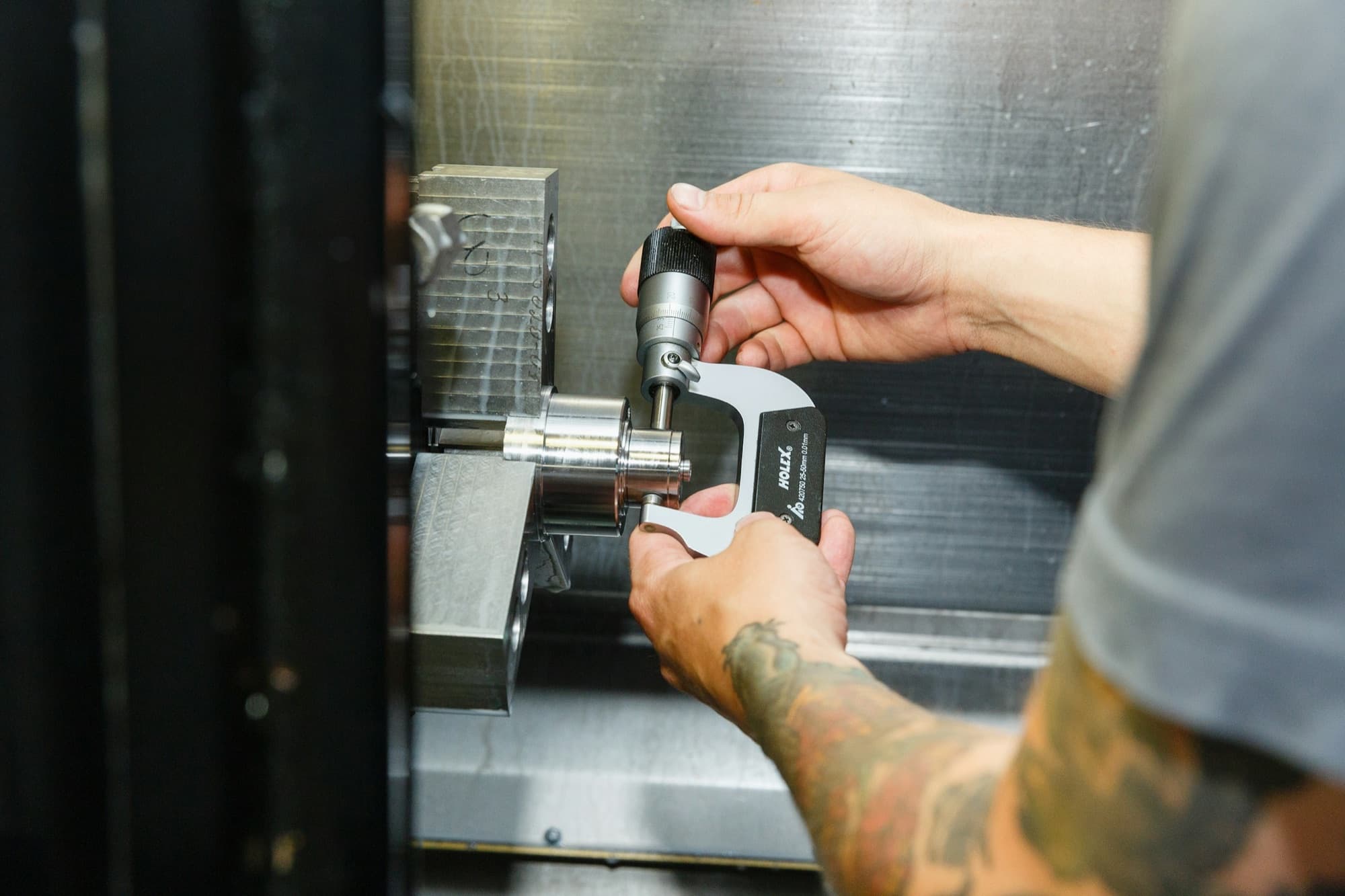
Final inspection checks the finished part, including thread gauges, hardness, plating thickness and appearance.
What is typically in scope?
Typical ranges across principals. Your drawing, material and quantity set the real numbers in the quote.
| Tapping | UNC, UNF and metric threads, class 2B / 6H typical, verified with go/no-go gauges |
|---|---|
| Deburring | Vibratory, tumble, brush or thermal; edge break 0.005–0.015 in (0.13–0.38 mm) typical |
| Heat treat | Through hardening, carburizing, nitriding, stress relief; certs with hardness results |
| Plating and coating | Zinc to ASTM B633, electroless nickel, anodize to MIL-A-8625, powder coat |
| Pad printing | 1–4 colors; line width ≥ 0.006 in (0.15 mm) |
| Ultrasonic welding | Thermoplastics; energy directors 0.010–0.025 in (0.25–0.6 mm) tall |
| Outside processor lead time | Adds 3–10 working days per operation |
When should a principal handle secondary operations?
Best for
- Parts that need threads, clean edges, hardness or a finish before use
- Programs that want one supplier accountable for the finished part
- Heat treat and plating managed with certs tied to each lot
- Marking, printing and welding done before the parts ship
Pick something else when
- Features the primary process can make: mold, cast or roll the thread instead of tapping
- Finishes you already buy under contract with a qualified processor
- Operations that change the design every lot
Should the principal handle secondary operations, or someone else?
Typical values. Pick an alternative to see where each one wins.
Principal handles it compared with
Principal handles itDesigned out
- Precisionlooser → tighter
- Volume it pays atone-offs → millions
- Upfront toolingnone → heavy
- Shape freedomnarrow → wide
Principal handles it · pick it when
The operation is on the drawing and the principal can do it or manage the outside processor.
Designed out · pick it when
The feature can be molded, cast, formed or thread-rolled in the primary process, so no second operation is needed.
MethodTypical toleranceEconomic volumeToolingLead time
- Principal handles itthis pageTypical toleranceTo the drawingEconomic volumeAny production volumeToolingFixtures and gauges, often under $2,000Lead timeIn house: hours to days; outside processor: 3–10 days
- Typical toleranceHeld by the primary processEconomic volumeAnyToolingOften more complex primary toolingLead timeNo added days
- Typical toleranceTo the drawingEconomic volumeAnyToolingTheirsLead timeAdds freight both ways and 1–2 weeks
Which design rules keep secondary operations affordable?
Rules of thumb principals apply at DFM review. Each one has a reason.
RuleTargetWhy
- Thread depth
- 1.5× diameter in steel; 2× in aluminum
- Deeper threads add tap time and breakage without adding strength.
- Plating allowance
- Dimension before or after plating, and say which
- Zinc adds 0.0002–0.0005 in (5–13 µm) per surface, which matters on threads and fits.
- Heat treat distortion
- Leave grind stock on precision features
- Hardening moves parts. Finish-grind critical diameters after heat treat.
- Edge break
- Specify a range, not 'break all edges'
- A number sets the deburr method and makes inspection possible.
- Masking
- Call out masked areas clearly
- Masking is hand labor; fewer masked areas cost less.
What drives the cost of secondary operations?
In order of impact.
- 1
Lot charges
Outside processors charge a minimum per lot, so small lots of plated or heat-treated parts carry a heavy per-part cost.
- 2
Handling and freight
Every hand-off adds packing, freight and receiving.
- 3
Masking and racking
Hand masking and rack plating cost more than barrel work.
- 4
Cycle time
Tapping and printing add machine seconds per part.
- 5
Inspection and certs
Hardness testing, plating thickness checks and certs are part of the price.
Secondary operations questions
Does SSG do heat treating or plating?
No. SSG is a manufacturers' representation firm. Principals in the network do in-house secondary operations or manage qualified outside processors for heat treat and plating, and quote the finished part.
Why do secondary operations add so much lead time?
Heat treat and plating are usually batch processes at outside shops, each adding 3–10 working days plus freight both ways. In-house steps like tapping and deburring add hours to days.
Can a thread be made without tapping?
Often. Threads can be molded in plastic, cast in zinc, rolled on screw machine parts, or formed with thread-forming screws. Designing the thread into the primary process removes a step.
What certs come with plated or heat-treated parts?
A certificate from the processor stating the spec, such as ASTM B633 for zinc plating, with thickness or hardness results tied to the lot number. Ask for them on the RFQ.
What is ultrasonic welding used for?
Joining molded thermoplastic parts, such as housing halves, without screws or adhesive. High-frequency vibration melts a small energy director at the joint in under a second.
Quote the finished part, secondary operations included.
Put the operation on the drawing and the RFQ. A rep routes it to principals that offer it, so one quote covers the finished part.