Loading page
Network line, now onboarding principals
Assembly and kitting
Many principals that make parts will also assemble them: pressing in pins and bearings, installing fasteners and threaded inserts, building sub-assemblies, and kitting, packaging and labeling to your spec. SSG sources this through principals that offer it and quotes it with the part, so you receive one part number instead of several. Expect it to add 1–3 weeks to the first shipment.
SSG does not run these operations. Principals that offer them do the work and quote it with the part, and your rep manages it on one purchase order.
How is assembly sourced and run?
Pick a line on the bill of materials to see where it goes.
| # | Part | Qty | Source |
|---|---|---|---|
| Base housing | 1 | Molded by the principal | |
| Threaded insert, brass | 2 | Bought, pressed in | |
| Bracket | 1 | Stamped | |
| Cover | 1 | Molded | |
| Screw | 2 | Bought, torqued to spec | |
| Label and carton | 1 | To your packaging spec |
- 1
Define the assembly
An assembly drawing, bill of materials, torque and press-fit specs, and a packaging spec go on the RFQ.
- 2
Match a principal
SSG routes it to principals that make the main components and offer assembly, so parts are not shipped between plants.
- 3
Build fixtures and instructions
The principal builds nests, press tooling and a written work instruction, and proves them on a pilot build.
- 4
First article of the assembly
The first assemblies are inspected against the drawing, including torque, press-fit depth and function checks.
- 5
Produce, kit and pack
Assemblies are built, bagged or packed, labeled with your part number and lot, and shipped as one line item.
What is typically in scope?
Typical ranges across principals. Your drawing, material and quantity set the real numbers in the quote.
| Typical scope | Press-fit, fasteners, inserts, riveting, staking, sub-assembly, kitting, packaging, labeling |
|---|---|
| Press-fit interference | 0.0005–0.002 in (0.013–0.05 mm) typical for steel pins in aluminum |
| Fastener torque | To the drawing, with calibrated drivers and a record per lot |
| Economic volume | About 500 assemblies and up |
| Fixture cost | $500–$10,000 depending on the assembly |
| Added lead time | 1–3 weeks on the first shipment; none on repeats |
| Documentation | Work instruction, first article of the assembly, packaging spec |
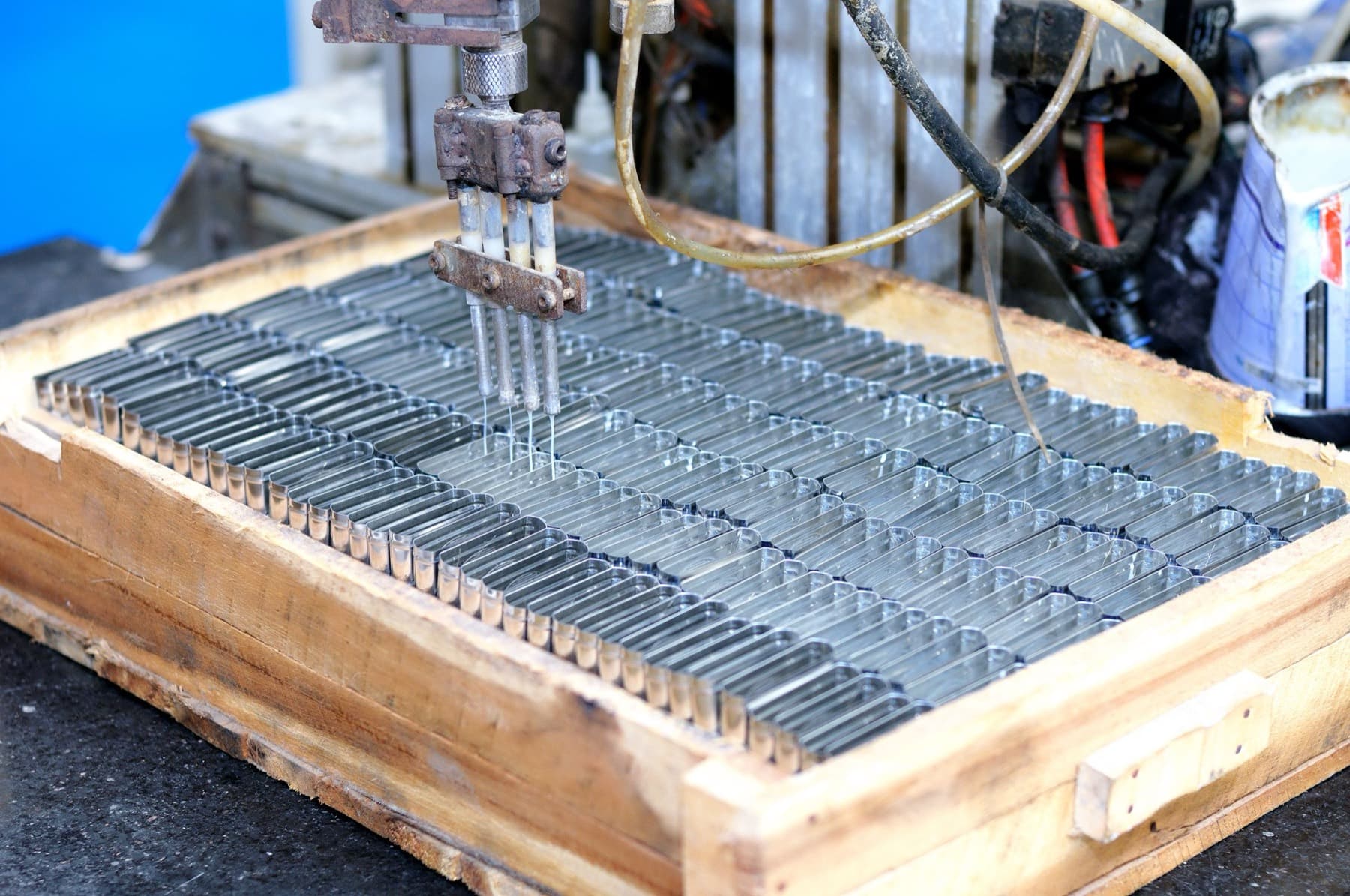
Multi-needle dispensing head working over a tray of formed metal ferrules.
When should a principal handle assembly?
Best for
- Sub-assemblies where the principal already makes most of the content
- Press-fit pins, bushings and bearings; PEM and heat-set inserts
- Kits bagged and labeled to a bill of materials
- Dock-to-line packaging: returnable totes, layer pads, barcode labels
Pick something else when
- Assemblies with PCBs, wiring and functional test: an electronics contract manufacturer
- Designs still changing every build: assemble in house until they settle
- Final assembly that is your core process and competitive edge
Should the principal handle assembly, or someone else?
Typical values. Pick an alternative to see where each one wins.
Principal assembles compared with
Principal assemblesYour plant
- Precisionlooser → tighter
- Volume it pays atone-offs → millions
- Upfront toolingnone → heavy
- Shape freedomnarrow → wide
Principal assembles · pick it when
The principal already makes most of the content, and you want one part number on the dock.
Your plant · pick it when
Final assembly is your core process, the design is still changing, or the parts come from many sources.
MethodTypical toleranceEconomic volumeToolingLead time
- Principal assemblesthis pageTypical toleranceTo the assembly drawing and work instructionEconomic volume500 assemblies and upToolingFixtures $500–$10,000Lead timeAdds 1–3 weeks to first shipment
- Typical toleranceYour processEconomic volumeAnyToolingYour fixturesLead timeYour schedule
- Typical toleranceTo their quality planEconomic volume1,000 assemblies and upToolingFixtures and test standsLead timeAdds freight and 1–2 weeks
Which design rules keep assembly affordable?
Rules of thumb principals apply at DFM review. Each one has a reason.
RuleTargetWhy
- Fastener count
- Fewer, same size
- Every extra fastener adds a pick, a start and a drive. One size means one driver.
- Self-locating parts
- Pins, tabs or pilots
- Parts that only fit one way remove fixtures and orientation errors.
- Press-fit spec
- Interference and force on the drawing
- Force monitoring catches a missing or undersized part at the station.
- Assembly direction
- Top-down, one axis
- Every re-orientation is handling time and a fixture.
- Label content
- Part number, revision, quantity, lot, date
- Makes receiving and traceability work without opening the box.
What drives the cost of assembly?
In order of impact.
- 1
Labor per assembly
Touch time per unit, at the principal's labor rate. Design for assembly moves this more than anything.
- 2
Purchased components
Fasteners, inserts, bearings and labels bought by the principal carry a handling margin.
- 3
Fixtures and tooling
One-time nests, press tools and gauges.
- 4
Packaging
Custom dunnage, returnable totes and printed labels.
- 5
Testing
Leak, function or torque-audit tests add station time.
Assembly questions
Does SSG assemble parts?
No. SSG is a manufacturers' representation firm. Assembly is done by principals in the network that offer it, and it is quoted with the parts they make. Your rep manages the RFQ, the first article and any changes.
What is kitting?
Kitting groups the parts needed for one assembly or job into one bag, box or tray, labeled to a bill of materials. It saves picking time on your line and cuts missing-part stoppages.
What should an assembly RFQ include?
The assembly drawing and bill of materials, torque and press-fit specs, any test requirements, the packaging and label spec, and annual volume. List purchased parts you supply, if any.
Can the principal buy the hardware?
Usually. Principals buy fasteners, inserts and bearings to your approved list and include them in the price. You can also consign parts you already buy.
How is assembly quality checked?
A first article on the assembly, then in-process checks such as torque audits, press-force monitoring, go/no-go gauges or function tests, recorded per lot.
Quote the finished part, assembly included.
Put the operation on the drawing and the RFQ. A rep routes it to principals that offer it, so one quote covers the finished part.