Powdered metal parts: MPIF 35 materials, density, cost
SSG MFG engineering5 min readPowdered metal
When is powdered metal the right process for a part?
Powdered metal (PM) is the right process for small, complex steel, stainless, or bronze parts made at about 10,000 to millions per year. Pressing powder in a die and sintering it produces net or near-net shapes with over 95% material use, often at a fraction of the cost of machining. Typical parts weigh under 2 lb (0.9 kg) and reach 6.4–7.2 g/cm³ density.

How is a powdered metal part made?
- Blend: metal powders are mixed with alloying additions such as copper, nickel, and graphite, plus about 0.5–1% lubricant.
- Compact: the powder is pressed in a rigid carbide or tool steel die, typically at 25–50 tons per square inch (345–690 MPa), into a green part.
- Sinter: the green part is heated in a protective atmosphere, about 2,050°F (1,120°C) for iron-based parts, so the particles bond metallurgically.
- Size or coin (optional): a second pressing tightens dimensions and densifies the surface.
- Secondary operations (optional): heat treating, steam treating, oil or resin impregnation, machining, and plating.
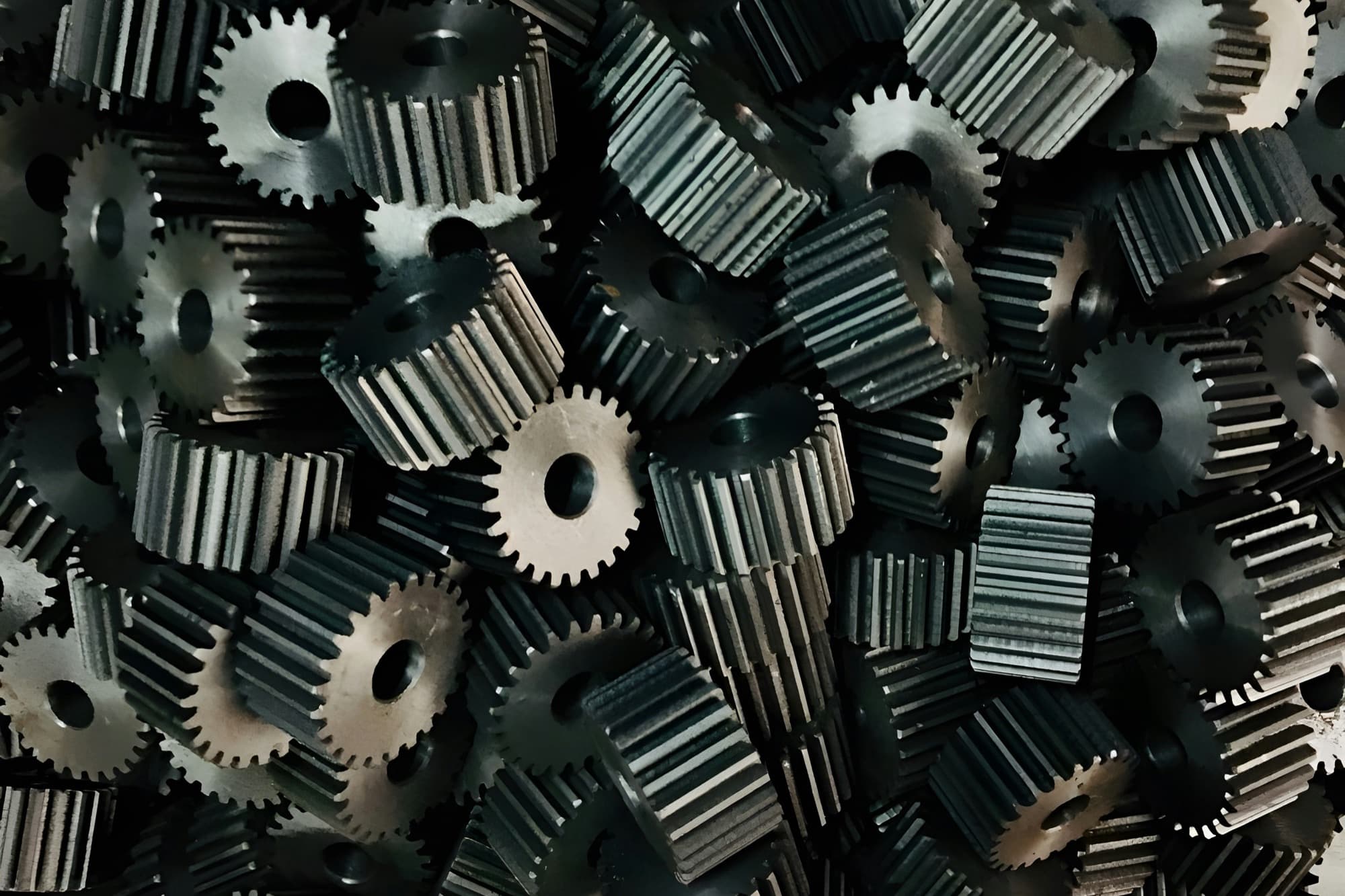
Because the die fills from the top and presses along one axis, PM favors parts that are complex in plan view and simple in the press direction: gears, sprockets, cams, bushings, levers, and structural brackets.
What do MPIF Standard 35 material codes mean?
MPIF Standard 35 is the Metal Powder Industries Federation's materials standard for PM parts. A code such as FC-0208-50 reads as follows: F is iron, C is copper, 02 is 2% copper, 08 is 0.8% combined carbon, and 50 is a minimum yield strength of 50,000 psi as sintered. Heat-treated grades end in HT, and their number is the minimum ultimate tensile strength in thousands of psi.
| Material | Composition | Typical density | Typical use |
|---|---|---|---|
| F-0000 | Plain iron | 6.1–7.2 g/cm³ | Soft magnetic parts and lightly loaded components |
| F-0008 | Iron, 0.8% carbon | 6.1–7.0 g/cm³ | Low-cost structural parts at moderate loads |
| FC-0208 | Iron, 2% copper, 0.8% carbon | 6.0–7.2 g/cm³ | The most-used PM steel: gears, sprockets, cams |
| FN-0205 | Iron, 2% nickel, 0.5% carbon | 6.6–7.2 g/cm³ | Heat-treated parts needing toughness and wear resistance |
| SS-316L | 316L stainless | 6.4–6.9 g/cm³ | Corrosion-resistant parts; sintered at higher temperature |
| CT-1000 | Bronze, 90% copper, 10% tin | 5.8–7.2 g/cm³ | Oil-impregnated self-lubricating bearings |
How does density affect powdered metal strength?
Wrought steel is about 7.87 g/cm³. Most PM steel parts press to 6.4–7.2 g/cm³, roughly 8–19% porosity. Tensile strength, fatigue strength, impact energy, and ductility all rise with density, and impact energy and ductility rise fastest near full density.
- Single press and sinter: about 6.4–7.0 g/cm³ for most iron-based parts.
- Double press and double sinter, or warm compaction: about 7.2–7.4 g/cm³ for higher strength.
- Powder forging: close to full density, used for high-load parts such as connecting rods.
- Metal injection molding (MIM): 95–99% density for very small, complex parts, at higher tooling and material cost.
Porosity can also be useful. Bronze and iron bearings are impregnated with oil through their pores and lubricate themselves in service, and steam treating forms a hard oxide that seals the surface and improves wear resistance.
What design rules apply to powdered metal parts?
- Keep features pressable: no undercuts, cross holes, or threads perpendicular to the press direction. Those are machined after sintering.
- Keep part height to about 2–3× diameter or less; tall parts develop a density gradient toward the middle.
- Hold walls to at least 0.060 in (1.5 mm); thinner walls fill poorly and crack tooling.
- Avoid knife edges and feather-edged punches; add a small flat to chamfers.
- Each separate level in the press direction needs its own punch, which adds tool cost and complexity.
- No draft is needed on walls formed by the die.
Typical tolerances are ±0.001–0.002 in per inch (±0.001–0.002 mm/mm) on diameters formed by the die as sintered, about ±0.0005 in (±0.013 mm) after sizing, and ±0.003–0.005 in (±0.08–0.13 mm) on lengths in the press direction.
Press capacity limits part size. Required tonnage is roughly projected area times compaction pressure, so a part with 3 in² (19 cm²) of projected area pressed at 40 tsi needs a 120-ton press before any safety margin.
When does powdered metal beat machining?
| Process | Economic volume | Tooling | Material use | Density vs wrought |
|---|---|---|---|---|
| Powdered metal | 10,000 to millions per year | $5,000–$50,000 | About 97% | 81–92% |
| Machining from bar | 1 to hundreds of thousands | Fixtures only | Often 30–70% | 100% |
| Metal injection molding | 10,000 and up | $20,000–$100,000 | About 95% | 95–99% |
| Investment casting | 100 to 100,000 | $2,000–$25,000 | Near net | Close to 100% |
PM wins when a part has a complex outline, such as gear teeth, splines, lobes, or keyed bores, and volume is high enough to pay for the die set. Machining wins at low volume, for full-density parts under high impact or fatigue, and for parts with many cross features.
How do you get a powdered metal part quoted?
Upload a STEP file or configure the part in the SSG builder at /build for an instant budgetary estimate and a DFM check on wall thickness, height-to-diameter ratio, and pressable features. Include the MPIF material and density, heat treatment, annual volume, and any post-sinter machining. An SSG rep then routes the RFQ to PM principals matched to the part size and material, and returns firm quotes.