Forging guide: closed die, open die, and grain flow
SSG MFG engineering7 min readForging
What is forging and when should you use it?
Forging shapes metal by compressing it between dies, so the grain follows the contour of the part instead of being cut through. That gives forgings higher fatigue and impact strength than castings or parts machined from bar. Closed-die forging usually pays off above about 1,000 parts a year, with dies typically costing $10,000–$50,000 for small-to-medium parts.
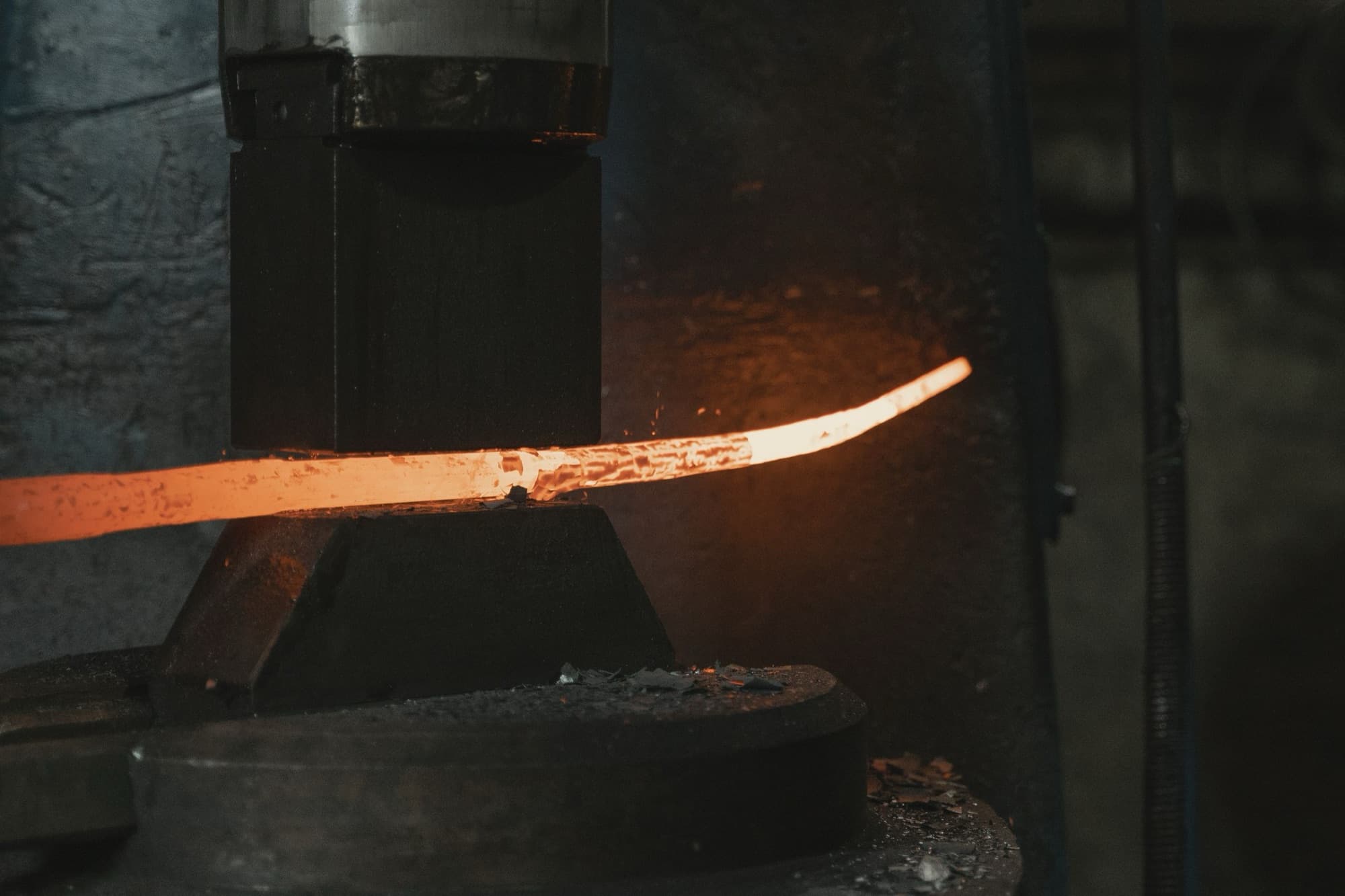

What is forging?
Forging shapes metal by compressing it between dies with a hammer or press. The metal stays solid the whole time, so there is no molten metal, no gating, and no shrinkage porosity. Most production forging is hot: steel is typically forged at 2,000–2,300 °F (1,100–1,250 °C) and aluminum at roughly 700–900 °F (370–480 °C). Cold and warm forging trade higher press loads for tighter tolerances, better surface finish, and less scale.
- Closed-die (impression-die) forging: the heated billet fills a shaped cavity in matched dies. Excess metal escapes as flash and is trimmed off. This is the production workhorse for parts from a few ounces to a few hundred pounds.
- Open-die forging: the work is shaped between flat or simple dies and repositioned between blows. Used for shafts, blocks, discs, and large parts from a few pounds to more than 100 tons.
- Rolled ring forging: a pierced blank is rolled out into a ring for bearing races, flanges, and gear blanks.
- Upset forging and cold heading: the end of a bar or wire is gathered to form heads and collars on bolts, pins, and valve stems.
What is the difference between closed-die and open-die forging?
Closed-die forging makes near-net shapes repeatably but needs a dedicated set of dies for each part. Open-die forging uses general-purpose tooling, so it costs little to start but leaves much more material to machine off. The choice usually comes down to quantity and size.
| Attribute | Closed-die (impression) | Open-die |
|---|---|---|
| Tooling cost | $10,000–$50,000 for small-to-medium parts; more for large or multi-impression dies | Little or none; standard flat, V, and swage dies |
| Economic quantity | About 1,000 parts per year and up | One piece to a few hundred |
| As-forged tolerance | ±0.015–0.030 in (±0.4–0.8 mm) | ±0.125 in (±3 mm) or looser |
| Machining stock | 0.06–0.12 in (1.5–3 mm) per surface | 0.25 in (6 mm) or more per surface |
| Draft | 5–7° external on steel | None required |
| Typical parts | Connecting rods, yokes, levers, gear blanks, hand tools, lifting hardware | Shafts, rolls, blocks, discs, large flanges and rings |
Why does grain flow matter in forged parts?
Wrought bar and billet already have a fibrous grain structure aligned with the rolling direction. Forging bends that grain to follow the outline of the part, so the fibers run around fillets and through transitions instead of ending at the surface. Machining a part from bar cuts across those fibers and exposes end grain, which is where fatigue cracks tend to start. A casting has no directional grain at all and can carry shrinkage porosity in thick sections.
- Fatigue life: grain that follows the contour resists crack initiation at fillets, radii, and section changes.
- Impact toughness: forged steels typically retain toughness at low temperature better than castings of similar chemistry.
- Internal soundness: forging pressure closes centerline voids left from the original ingot or billet.
- Directional properties: strength across the grain is lower than along it, so orient the flow along the main load path.
Forging vs casting vs machining from bar: which should you choose?
All three can make the same part. The right one depends on how the part is loaded, how complex it is, and how many you need each year.
| Factor | Closed-die forging | Casting | Machined from bar |
|---|---|---|---|
| Fatigue and impact strength | Highest; grain follows contour | Lowest; porosity possible | Good; end grain exposed at cut surfaces |
| Geometry freedom | Moderate; needs draft, no internal cavities or undercuts | Highest; cores, thin walls, internal passages | High; limited by tool access |
| Tooling cost | $10,000–$50,000+ | $5,000–$100,000+ depending on process | None to low (fixtures) |
| Economic volume | About 1,000 to 100,000+ per year | About 500 to 500,000+ per year | 1 to about 10,000 per year |
| As-produced tolerance | ±0.015–0.030 in (±0.4–0.8 mm) | ±0.002–0.010 in die cast; ±0.030–0.060 in sand cast | ±0.001–0.005 in (±0.025–0.13 mm) |
| Material use | Good; flash is the main loss | Very good; gates and runners are remelted | Poor on complex shapes; chips can exceed half the bar |
| Lead time to first article | 6–12 weeks with new dies | 6–14 weeks with new tooling | 1–4 weeks |
The honest calls: forge safety-critical and fatigue-loaded parts such as suspension arms, lifting hooks, and high-pressure fittings. Cast parts with internal passages, thin walls, or complex shapes under moderate load. Machine from bar below a few hundred parts a year or while the design is still changing, then move to forging when volume and design settle.
What are the design rules for closed-die forgings?
| Rule | Typical value | Why |
|---|---|---|
| External draft | 5–7° | Lets the part release from the die; precision forgings go to 0–1° |
| Internal draft | 7–10° | Metal shrinks onto internal die features and grips them |
| Corner radius | 0.06–0.12 in (1.5–3 mm) minimum on small parts | Sharp corners don't fill and wear dies quickly |
| Fillet radius | 0.12–0.25 in (3–6 mm) minimum | Tight fillets cause laps and folds as metal flows |
| Web thickness | 0.12–0.25 in (3–6 mm) minimum, more on large plan areas | Thin webs chill fast and need very high tonnage |
| Machining allowance | 0.06–0.12 in (1.5–3 mm) per surface | Cleans up scale, decarburization, and die mismatch |
| Parting line | At the largest section, in one flat plane if possible | Flat parting lines cost less and control mismatch |
- Avoid undercuts and internal cavities. Machine them afterward.
- Through holes can often be pierced in the trim die. Blind holes are forged as shallow pockets and finished by machining.
- Keep section changes gradual. Abrupt changes starve the far side of the die cavity.
- Tolerance die mismatch, flash extension, and straightness separately from size, the way forgers quote them.
Which metals are commonly forged?
| Material | Common grades | Typical uses |
|---|---|---|
| Carbon steel | 1018, 1045, 1050 | Shafts, levers, flanges, general hardware |
| Alloy steel | 4140, 4340, 8620 | Gears, axles, high-strength and carburized parts |
| Stainless steel | 304, 316, 17-4PH | Valve bodies, food equipment, marine hardware |
| Aluminum | 6061, 2014, 7075 | Lightweight structural parts, aerospace and recreation fittings |
| Copper alloy | C37700 forging brass | Plumbing valves and fittings |
| Titanium | Ti-6Al-4V | Aerospace and medical parts |
Common specifications include ASTM A788 (general requirements for steel forgings), ASTM A105 (carbon steel forgings for piping components), ASTM B247 (aluminum die, hand, and rolled ring forgings), and EN 10243-1 (dimensional tolerances for steel die forgings). Call out heat treatment and a hardness range on the drawing, for example 4140 quenched and tempered to 28–32 HRC.
What drives the cost of a forging?
- Material: forged weight includes flash and machining stock, so input weight is often well above finished weight.
- Dies: initial die cost, die life, and resinking or replacement over the program.
- Equipment size and hits per part: larger parts need bigger presses or hammers and more reheats.
- Heat treatment: normalize, quench and temper, or solution treat and age.
- Machining: every surface held tighter than as-forged tolerance adds an operation.
- Testing: macroetch, ultrasonic inspection, and mechanical testing when specified.
How do you source forgings through SSG?
Start in the part builder at /build. Upload a STEP file of the finished part, pick the alloy and annual quantity, and get an instant budgetary estimate with DFM feedback. For firm pricing, an SSG rep routes the RFQ to principals whose press range, alloys, and certifications match the part, and stays on it through first article. Independent reps with forging customers can join the network at /network and submit those jobs directly.