Aluminum die casting guide: A380 vs zinc, draft, walls
SSG MFG engineering5 min readDie casting
When should you use aluminum die casting instead of zinc?
Use aluminum die casting, most often alloy A380, for lightweight housings, brackets, and enclosures at volumes above a few thousand parts per year. Choose zinc (Zamak 3 or 5) for smaller, detailed parts that need thinner walls, tighter tolerances, less draft, or a plated finish. Zinc dies also last several times longer, often 500,000 shots or more versus about 100,000 for aluminum.

What is aluminum die casting?
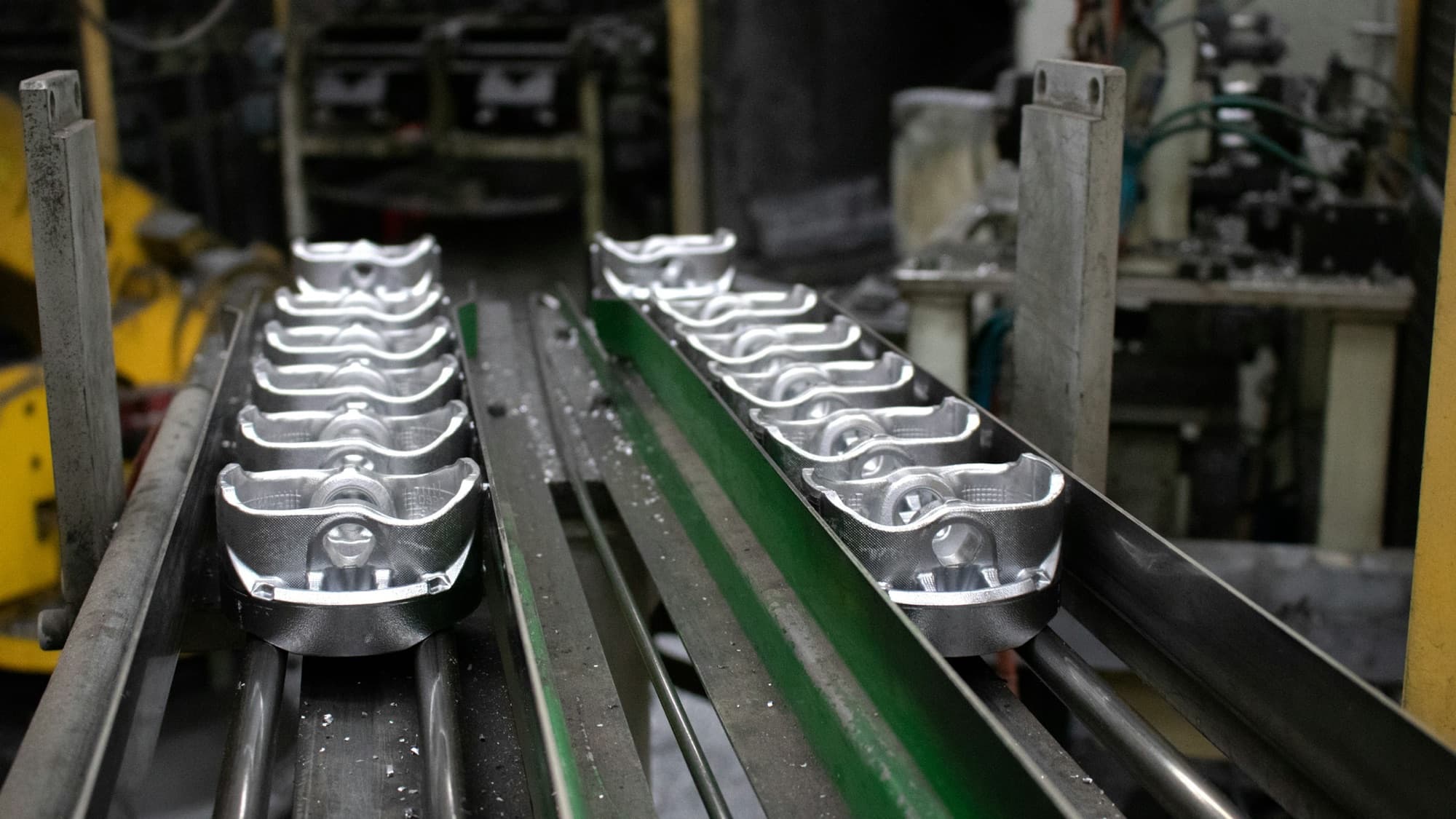
Die casting injects molten metal at high pressure into a hardened steel die, usually H13 tool steel, and ejects a near-net part in seconds. Aluminum runs on cold-chamber machines, where metal is ladled into a shot sleeve each cycle, because molten aluminum attacks the submerged components of a hot-chamber machine. Zinc runs on faster hot-chamber machines.
The process makes thin-walled, detailed parts with good surface finish and repeatable dimensions at high volume. Most parts need some machining on sealing faces, bores, and threads, but far less than a part machined from solid.
How does A380 aluminum compare to zinc die casting alloys?
| Property | A380 aluminum | Zamak 3 | Zamak 5 |
|---|---|---|---|
| Density | 0.098 lb/in³ (2.71 g/cm³) | 0.24 lb/in³ (6.6 g/cm³) | 0.24 lb/in³ (6.7 g/cm³) |
| Ultimate tensile strength | 47 ksi (324 MPa) | 41 ksi (283 MPa) | 48 ksi (331 MPa) |
| Elongation | 3.5% | 10% | 7% |
| Melting range | 1,000–1,100°F (540–595°C) | 718–728°F (381–387°C) | 717–727°F (380–386°C) |
| Thermal conductivity | 96 W/m·K | 113 W/m·K | 109 W/m·K |
| Typical wall | 0.080–0.120 in (2.0–3.0 mm) | 0.040–0.080 in (1.0–2.0 mm) | 0.040–0.080 in (1.0–2.0 mm) |
| Typical die life | 75,000–150,000 shots | 500,000 to over 1,000,000 shots | 500,000 to over 1,000,000 shots |
A380 is an aluminum-silicon-copper alloy with about 8.5% silicon and 3.5% copper. It balances castability, strength, and cost, which is why it is the default. A360 offers better corrosion resistance and pressure tightness, and A383 fills thin, intricate sections more easily.
Zinc costs more per pound and weighs about 2.4 times as much, but on small parts it often wins on total cost through faster cycles, longer die life, thinner walls, and less machining. It also plates well for decorative chrome and nickel finishes.
How much draft does a die casting need?
Draft lets the casting release from the die as it shrinks. Aluminum needs roughly twice the draft of zinc. Typical starting points are 1° on outside walls and 2° on inside walls and cores for aluminum, and about 0.5° outside and 1° inside for zinc.
NADCA's draft formula makes the required draft distance grow with the square root of depth, so a deep wall needs a smaller angle than a shallow one. Inside walls and cores need more draft because the casting shrinks onto them.
How thick should die cast walls be?
- Aluminum: about 0.080–0.120 in (2.0–3.0 mm) typical, down to about 0.040 in (1.0 mm) on small parts with short flow lengths.
- Zinc: about 0.040–0.080 in (1.0–2.0 mm) typical, down to about 0.025 in (0.6 mm) on small parts.
- Keep walls uniform. Sections over about 0.25 in (6 mm) are prone to shrinkage porosity.
- Core out heavy sections and add ribs for stiffness instead of mass.
- Radius inside corners at least 0.020–0.040 in (0.5–1.0 mm); larger radii improve metal flow and die life.
NADCA standard linear tolerance is about ±0.010 in (±0.25 mm) on the first inch, with added allowance for each additional inch and for dimensions across the parting line or moving die parts. Precision tolerances tighten the first inch to about ±0.002 in (±0.05 mm) for aluminum and ±0.0015 in (±0.04 mm) for zinc, at higher cost.
What causes porosity in die castings, and how is it controlled?
Gas porosity comes from air and die lubricant trapped during the fast fill. Shrinkage porosity forms in thick sections that solidify last without enough metal feeding them. Some porosity is normal in high-pressure die casting; the goal is to keep it out of sealing faces, threads, and highly stressed areas.
- Uniform walls and cored-out thick sections to avoid isolated hot spots.
- Gates, overflows, and vents placed to push air out of the cavity.
- Vacuum-assisted die casting for parts that must be pressure tight or welded.
- Porosity zones on the drawing, with acceptance levels referenced to ASTM E505 radiographs or CT scanning.
- Minimal machining stock, often 0.010–0.030 in (0.25–0.75 mm), because the dense skin is near the surface.
- Vacuum impregnation per MIL-STD-276 to seal leak paths in pressure-tight castings.
How long does a die casting die last, and what does it cost?
Aluminum dies wear out from heat checking, a network of fine surface cracks caused by thermal cycling at pour temperatures around 1,200°F (650°C). Typical life is 75,000–150,000 shots before major repair, depending on part size, steel, and maintenance. Zinc casts at much lower temperatures, and its dies often last 500,000 to over 1,000,000 shots.
A single-cavity aluminum die commonly costs from about $15,000 to over $100,000, driven by part size, slides, cavities, and cooling. A separate trim die removes the runner and overflows. A new die typically takes 8–16 weeks.
At low volume, usually under a few thousand parts a year, other processes often cost less in total.
- Machining from 6061 plate or bar: no tooling, full density, higher piece price.
- Sand casting in A356: low tooling cost, thicker walls, rougher finish.
- Permanent mold casting: moderate tooling, better strength, and heat-treatable alloys.
- Investment casting: fine detail at low to medium volume.
How do you get a die casting quoted?
Upload a STEP file or configure the part in the SSG builder at /build for an instant budgetary estimate and a DFM check on draft, wall thickness, and thick sections. Include alloy, annual volume, machined features, finish, and any leak-test or porosity requirements. An SSG rep then routes the RFQ to aluminum and zinc die casting principals matched to the part size and volume, and returns firm quotes.