Loading page
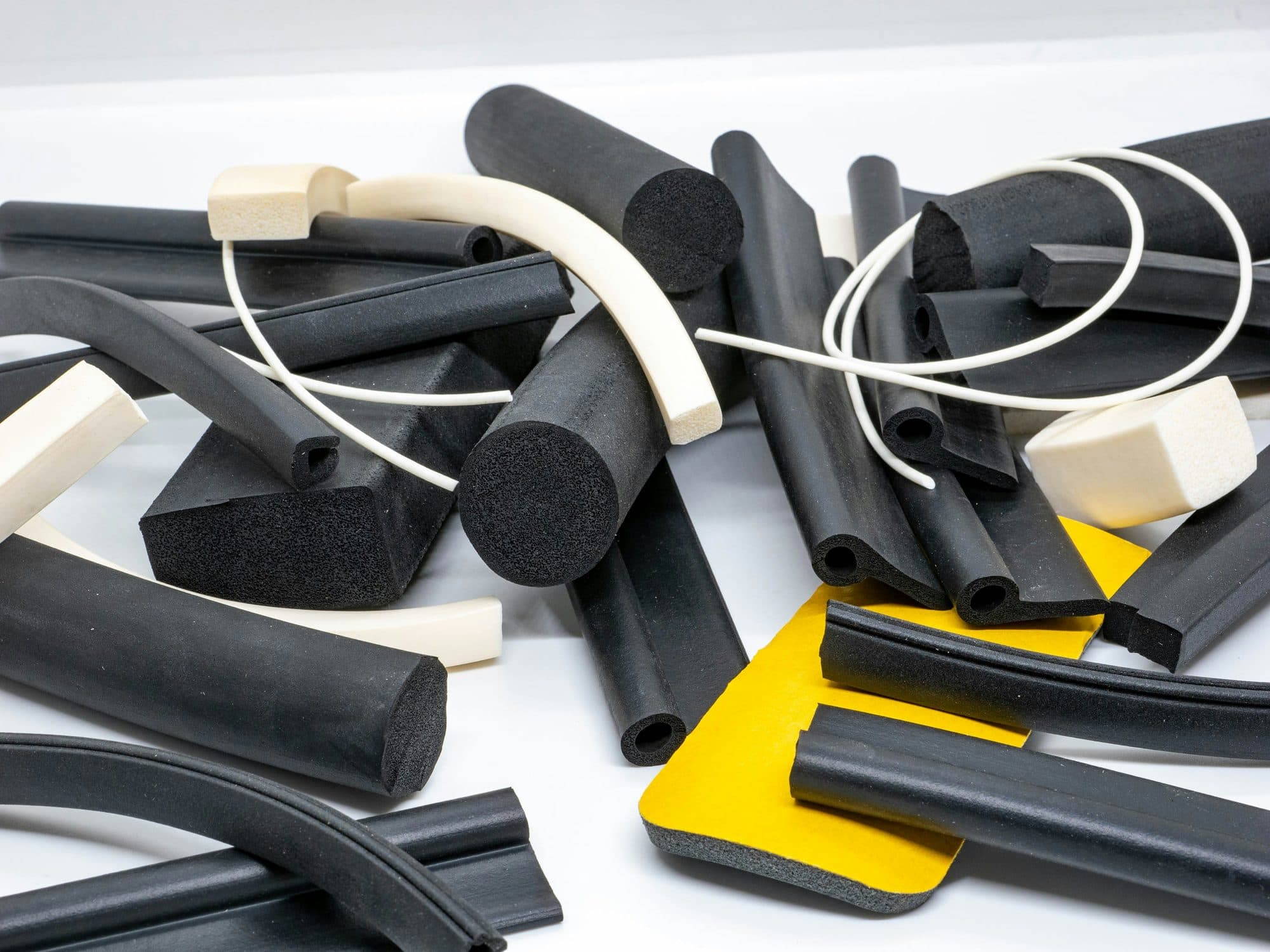
Rubber in EPDM rubber
EPDM rubber is one of the most economical choices for rubber: excellent ozone, uv and weather resistance. On a representative extruded seal at 5,000 pieces it estimates at about $1.32 per part plus $750 tooling, with a lead time of 3–4 weeks. Typical tolerance is ISO 3302-1 class E2 typical: ±0.010–0.020 in (±0.25–0.50 mm) on sections under 0.25 in (6 mm).
- Per part
- $1.32
- Tooling
- $750
- Lead time
- 3–4 weeks
Price it in EPDM
Extruded seal · Rubber
Order total $7,662
- Tooling
- $750
- one-time, spread over the order
- Piece price
- $1.32
- before setup + tooling
- Lead time
- 3–4 weeks
- to first production
Size
Drag a row to adjust · click to type
Profile width / OD12.012.0 mm
Hollow / ID7.007.00 mm
Cut length900900 mm
Quantity
Price per part falls as volume rises
Exact quantity50005000 pcs
Material
Design checks pass
Open in builderBudgetary estimate for a representative part. Firm quotes come from principals after drawing review.
EPDM vs other rubber materials
The same extruded seal at 5,000 pieces, priced in every material the process runs. TPE is the lowest all-in cost.
| Material | Per part | All-in | Weight | Tensile |
|---|---|---|---|---|
| TPE (thermoplastic elastomer) | $1.23 | $1.44 | 85 g | 7 MPa |
| EPDM rubber | $1.32 | $1.53 | 97 g | 12 MPa |
| Nitrile rubber (NBR) | $1.35 | $1.56 | 101 g | 14 MPa |
| Neoprene (CR) | $1.92 | $2.13 | 114 g | 14 MPa |
| Silicone rubber (VMQ) | $2.28 | $2.49 | 97 g | 8 MPa |
| FKM fluoroelastomer (Viton) | $12.70 | $12.90 | 156 g | 12 MPa |
EPDM at a glance
- Tensile strength
- 12 MPa4th pct
- Density
- 1.15 g/cm³17th pct
- Max service temp
- 150 °C55th pct
- Elongation
- 300 %89th pct
- Relative cost
- $$$$$
Bars are relative to the strongest, densest or hottest material in the SSG library. Percentile vs all 48 materials.
Strengths
- Excellent ozone, UV and weather resistance
- Handles hot water, steam, glycol coolants and brake fluid
- Service from about −60 to 300 °F (−50 to 150 °C) in peroxide-cured grades
- Good electrical insulation
- Low cost; extrudes easily as solid or sponge profiles
Watch for
- Swells and fails in petroleum oils, fuels and hydrocarbon solvents
- Sulfur-cured grades top out near 250 °F (120 °C); specify peroxide cure for heat
- Lower tear and abrasion resistance than natural rubber
Rubber design rules
About 0.030 in (0.8 mm) minimum, with even thickness around the profile
Keep walls uniform
15–30% compression for static seals; 10–20% for dynamic seals
Size seal squeeze
Seal volume no more than about 85% of groove volume
Limit gland fill
Inside corner radius at least 0.020 in (0.5 mm)
Radius corners
±5 Shore A points
Specify durometer tolerance
Place flash and mismatch on non-functional surfaces
Keep parting lines off sealing faces
Questions
How much does rubber in EPDM cost?
For a representative part (d-bulb extrusion 12 mm / 7 mm hollow, cut to 900 mm), SSG's estimator gives about $1.32 per part at 5,000 pieces, plus about $750 one-time tooling. All-in with tooling and setup that is $1.53 per part. It is budgetary; principals quote firm prices from your drawing.
Is EPDM a good material for rubber?
It is when you need excellent ozone, uv and weather resistance and handles hot water, steam, glycol coolants and brake fluid. Watch for swells and fails in petroleum oils, fuels and hydrocarbon solvents. Of 6 materials run in rubber, it ranks 2 on all-in cost for the same part.
What tolerance can rubber hold in EPDM?
Typical capability is ISO 3302-1 class E2 typical: ±0.010–0.020 in (±0.25–0.50 mm) on sections under 0.25 in (6 mm). Tighter tolerances are possible on called-out features at added cost; specify them on the drawing rather than as a blanket note.
Quote rubber in EPDM.
Upload your CAD or start from a template. The DFM check applies the rules above to your geometry.