Soft goods manufacturing: fabrics, patterns, sewing
SSG MFG engineering6 min readSoft goods
What is soft goods manufacturing?
Soft goods manufacturing turns fabric, webbing, foam, and hardware into sewn or welded products such as bags, covers, straps, cases, and pads. The core steps are pattern making, cutting, and sewing or RF welding. Fabric choice sets most of the cost and performance. Typical minimums run 300–1,000 units per style offshore, and custom-color fabric adds a 500–1,000 yard mill minimum.

What counts as soft goods?
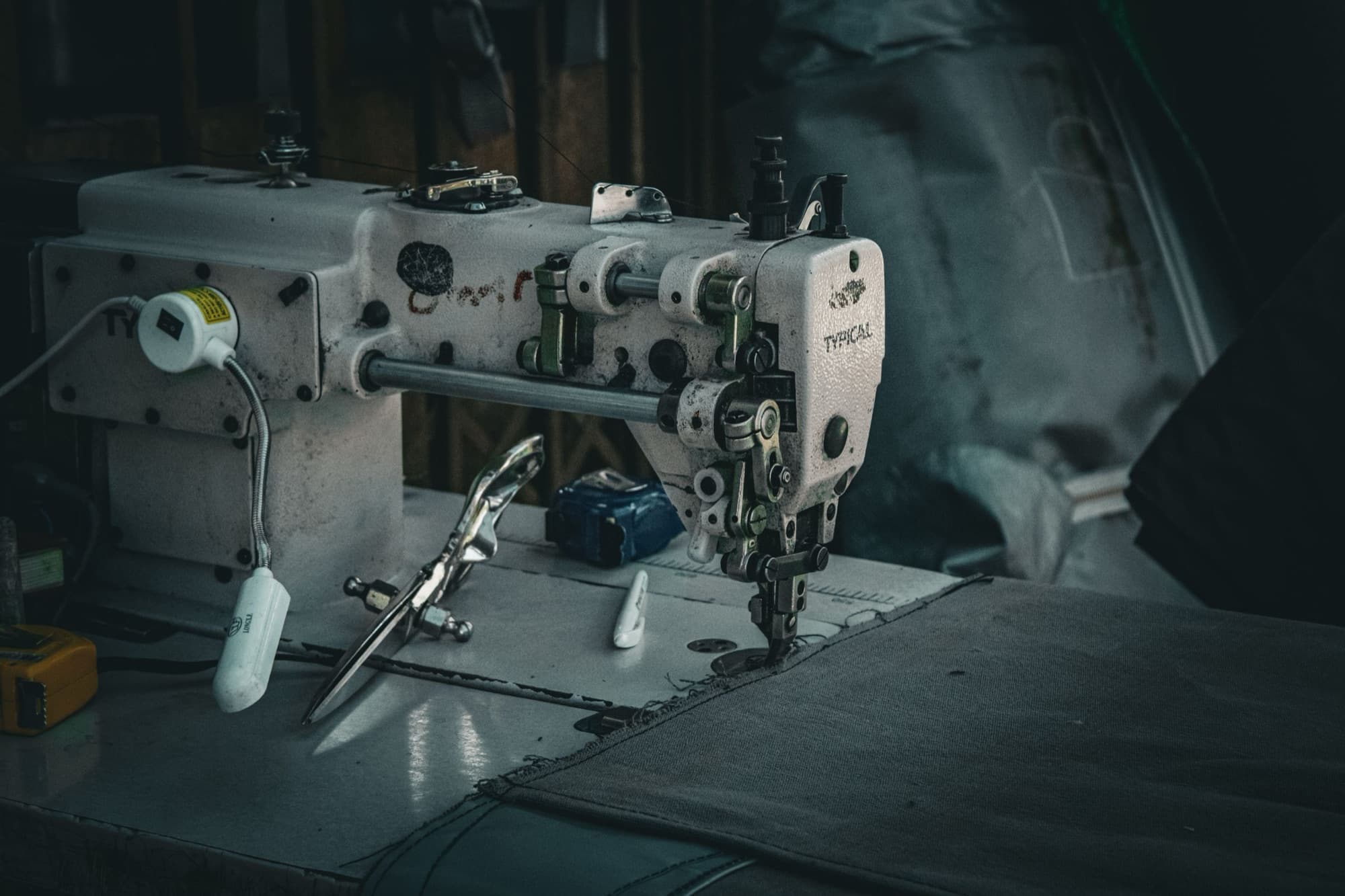
Soft goods are products made mainly from flexible materials: woven and knit fabrics, coated fabrics, webbing, foam, and film. For OEMs they are often components of a larger product rather than retail items. The difference from consumer sewing is discipline: fixed dimensions, materials traceable to a spec sheet, and repeatable construction from lot to lot.
- Equipment and machine covers, dust boots, and bellows
- Tool bags, instrument cases, pouches, and carrying cases
- Straps, harnesses, slings, and tie-downs
- Seat covers, cushions, and upholstered components
- Medical straps, positioning pads, and covers
- Industrial curtains, filter bags, and wraps
What does denier mean in fabric?
Denier is the mass in grams of 9,000 meters of a single yarn. A 1000D nylon is woven from heavier yarn than a 600D polyester. Denier alone does not define strength: fiber type, weave, yarn count, and coating matter as much. Fabric weight is stated separately, in ounces per square yard (oz/yd²) or grams per square meter (GSM).
| Fabric | Strengths | Trade-offs | Common uses |
|---|---|---|---|
| 1000D nylon (Cordura-type) | Very high abrasion and tear resistance | Heavier and costlier than polyester; UV fades nylon faster | Tool bags, heavy-duty cases, tactical gear |
| 1680D ballistic nylon | Highest abrasion resistance of common fabrics | Heavy, stiff, hard to sew tight radii | Luggage, tool rolls, protective cases |
| 600D polyester | Good UV resistance, low stretch, low cost | Lower abrasion resistance than nylon | Covers, promotional bags, light cases |
| 210D–420D nylon ripstop | Light, tear-stop grid | Lower abrasion resistance | Linings, lightweight packs, pouches |
| Vinyl-coated polyester (18 oz/yd²) | Waterproof, cleanable, RF weldable | Heavy; can stiffen and crack in cold | Tarps, curtains, equipment covers |
| TPU-coated nylon or polyester | Waterproof, weldable, PVC-free | Higher cost than PVC | Dry bags, bladders, medical covers |
| Cotton canvas (duck) | Heat tolerant, natural feel | Absorbs water; mildews unless treated | Aprons, tool bags, heat-exposed covers |
Which fabric coatings and tests should you specify?
- Polyurethane (PU) coating: light water resistance on the back face of nylon and polyester. Can hydrolyze after years in heat and humidity.
- PVC coating: heavy, waterproof, and RF weldable. Watch plasticizer migration and cold cracking.
- TPU coating or lamination: waterproof and weldable without PVC.
- Durable water repellent (DWR): makes water bead on the face. It is not waterproof and wears off.
- Silicone coating: light, high-temperature, used on some technical fabrics.
| Property | Test method | What it tells you |
|---|---|---|
| Abrasion | ASTM D4157 (Wyzenbeek) or ASTM D4966 (Martindale) | Cycles to wear-through or visible wear |
| Tear strength | ASTM D2261 (tongue) or ASTM D5587 (trapezoid) | Resistance to a tear spreading |
| Breaking strength | ASTM D5034 (grab) | Tensile load in warp and fill |
| Coated fabric properties | ASTM D751 | Coating adhesion, burst, and related properties |
| Water resistance | AATCC 127 (hydrostatic pressure) | Water column the fabric holds before leaking |
| Colorfastness to light | AATCC 16 | Fading under UV exposure |
| Flammability | FMVSS 302 (vehicle interiors), CPAI-84 (tents), NFPA 701 (drapery) | Burn rate or pass/fail by application |
How does cut-and-sew production work?
- Tech pack: sketches with dimensions, bill of materials, stitch and seam specs, labels, colors, and packaging.
- Pattern: flat pattern pieces drafted in CAD and exported as DXF, with seam allowances and notches.
- Sample: a sewn prototype for fit and function. Expect one to three rounds.
- Marker: pattern pieces nested across the fabric width. Tight markers use 80–90% of the fabric on well-shaped pieces.
- Cutting: by hand, CNC knife, laser, or steel rule die, depending on volume.
- Sewing or welding: stitched on lockstitch, chainstitch, and bar tack machines, or joined by RF, ultrasonic, or hot-air welding for coated fabrics.
- Hardware and finishing: zippers, buckles, grommets, snaps, binding, and labels.
- Inspection and pack-out: sampled by AQL per ANSI/ASQ Z1.4 or ISO 2859-1, then packed to spec.
| Method | Best volume | Tooling cost | Notes |
|---|---|---|---|
| Hand or straight knife | Prototypes to about 100 | None | Slow and operator-dependent |
| CNC knife | 100 to 10,000+ | None; digital pattern | Fast changeover, cuts multiple plies |
| Laser | 50 to 10,000+ | None | Seals synthetic edges; never laser-cut PVC, which releases corrosive gas |
| Steel rule die on clicker press | 5,000+ | About $200–$2,000 per die | Fastest and most consistent per piece |
Which stitch types and threads hold up in durable goods?
| Stitch | Class | Use |
|---|---|---|
| 301 lockstitch | 300 | Main seams; secure and the same on both sides |
| 401 chainstitch | 400 | Long seams at speed; can run back if a stitch breaks |
| 504 overedge (3-thread) | 500 | Edge finishing to stop fraying |
| 516 safety stitch | 500 | Overedge plus chainstitch in one pass |
| 602 / 605 coverstitch | 600 | Flat seams, hems, and binding |
| Bar tack | 300 (zigzag lockstitch) | Reinforcement at strap ends, loops, and stress points |
Bonded nylon thread gives the best strength and abrasion resistance. Bonded polyester resists UV and stretches less, so it is the usual choice outdoors. Tex 70 (size 69) covers light and medium goods, and Tex 135 (size 138) is common on heavy webbing and bags. Heavy fabrics typically run 6–10 stitches per inch; more stitches perforate coated fabric and weaken it.
What drives soft goods cost and minimum order quantity?
- Fabric: usually the largest material cost. Marker efficiency decides how many yards each unit consumes.
- Sewing minutes: every pocket, zipper, binding, and bar tack adds labor time. Labor is a large share of cost, so construction choices move price more than in automated processes.
- Hardware: zippers, buckles, and webbing in custom colors carry their own minimums.
- Setup: patterns, dies, samples, and line setup are spread over the run.
- Testing and compliance: flammability, colorfastness, and certification testing add cost per style.
| Item | Typical minimum | Note |
|---|---|---|
| Stock fabric, stock color | By the roll, often 50–100 yards | Available from converters and distributors |
| Custom color or coating | 500–1,000+ yards per color | A dedicated mill run |
| Custom-color webbing or zipper tape | Often 1,000+ yards | Stock colors avoid it |
| Sewn production, domestic | 100–500 units per style | Varies by complexity |
| Sewn production, offshore | 300–1,000+ units per style and color | Higher for custom materials |
How do you get soft goods made through SSG?
Soft goods rarely start with a STEP file, so start with what you have: a sample, a dimensioned sketch, or a tech pack. The builder at /build captures materials, quantities, and timing and gives a budgetary estimate and DFM feedback where the part fits its inputs. For firm quotes, an SSG rep routes the RFQ to cut-and-sew principals at your volume, domestic or offshore. Independent reps with soft goods customers can join the network at /network.