Rubber extrusion guide: compounds, durometer, tolerances
SSG MFG engineering6 min readRubber
How do you specify a custom rubber extrusion?
Specify a custom rubber extrusion by polymer (EPDM, silicone, neoprene, nitrile, or FKM), hardness in Shore A durometer (commonly 50–80 ±5), a dimensioned cross-section, an RMA tolerance class (E1 high precision, E2 precision, or E3 commercial), and finishing such as cut length, splices, or adhesive backing. An ASTM D2000 line callout defines the material properties.

What is rubber extrusion?
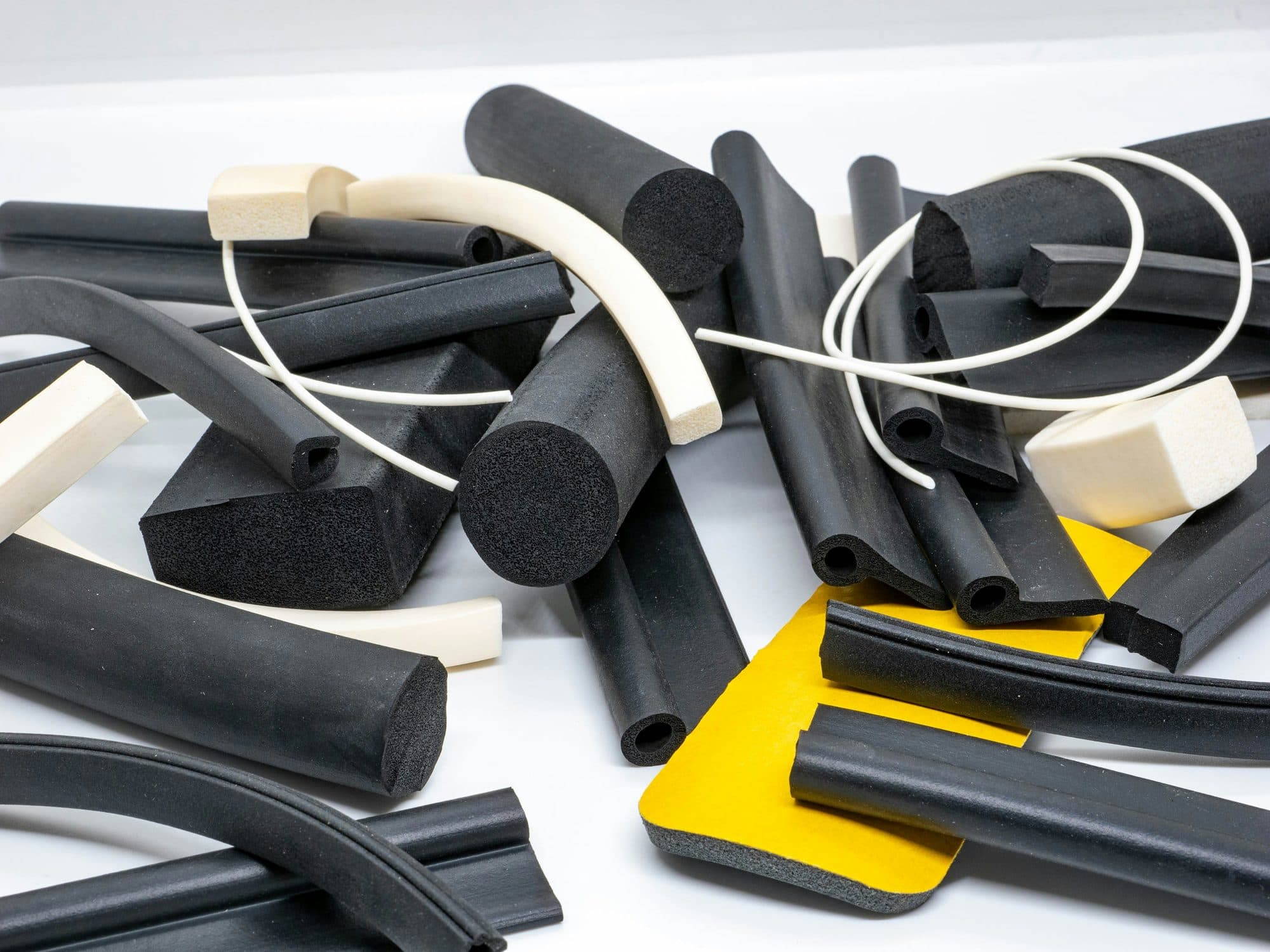
Rubber extrusion forces uncured compound through a shaped steel die to make a continuous profile, then vulcanizes it. Continuous lines cure with hot air, microwave (UHF), or a liquid salt bath; some profiles are cut raw and cured in an autoclave. The result is sold by the foot or as cut, spliced, or finished parts.
Extrusion dies are simple and relatively inexpensive, often a few hundred to a few thousand dollars, and typically take 2–4 weeks. That makes custom profiles practical at modest volumes. Common forms include solid seals, sponge gaskets, bulb seals, channels, tubing, and dual-durometer profiles that pair a firm base with a soft sealing bulb.
Which rubber compound should you choose?
| Polymer | Service temperature | Strengths | Avoid |
|---|---|---|---|
| EPDM | −40 to 300°F (−40 to 150°C) | Weather, ozone, UV, water, steam | Petroleum oils and fuels |
| Silicone (VMQ) | −75 to 450°F (−60 to 230°C) | Temperature extremes, low compression set, food and medical grades | Abrasion, tearing, fuels |
| Neoprene (CR) | −40 to 250°F (−40 to 120°C) | Moderate oil and weather resistance, flame resistance | Strong oxidizing acids, aromatic solvents |
| Nitrile (NBR) | −30 to 250°F (−35 to 120°C) | Petroleum oils, fuels, hydraulic fluids | Ozone and sunlight unless compounded for it |
| FKM (Viton) | −15 to 400°F (−26 to 205°C) | Fuels, oils, chemicals, high heat | Ketones and low temperatures; high cost |
Material properties are best written as an ASTM D2000 (SAE J200) line callout. In M2BC 710, M means metric units, 2 is the grade, B is the heat-resistance type (tested at 100°C), C is the oil-swell class, 7 is 70 durometer, and 10 is a 10 MPa minimum tensile strength. Suffixes add tests such as compression set, ozone, or fluid resistance.
What durometer should a rubber extrusion be?
Durometer is hardness measured on the Shore A scale per ASTM D2240. Solid extrusions typically run 40–90 Shore A, with a standard tolerance of ±5 points. Sponge rubber is too soft to measure this way and is specified by compression deflection under ASTM D1056 instead.
- 30–50 Shore A: soft seals with low closing force, cushioning, and irregular mating surfaces.
- 60–70 Shore A: the general-purpose range for gaskets, grommets, trim, and bumpers.
- 75–90 Shore A: wear strips, edge guards, and profiles that must hold their shape or resist extrusion under pressure.
- Dual durometer: a firm base, often 80–90 Shore A, that grips a panel or channel, co-extruded with a soft bulb for sealing.
What are the RMA extrusion tolerance classes?
The RMA tolerance classes, now maintained by the Association for Rubber Products Manufacturers (ARPM) in its Rubber Handbook, set cross-section tolerances for extruded profiles. E1 is high precision, E2 is precision, and E3 is commercial. ISO 3302-1 uses the same class names with matching metric values.
| Nominal dimension | E1 high precision | E2 precision | E3 commercial |
|---|---|---|---|
| Up to 0.06 in (1.5 mm) | ±0.006 in (±0.15 mm) | ±0.010 in (±0.25 mm) | ±0.016 in (±0.40 mm) |
| 0.06–0.10 in (1.5–2.5 mm) | ±0.008 in (±0.20 mm) | ±0.014 in (±0.35 mm) | ±0.020 in (±0.50 mm) |
| 0.10–0.16 in (2.5–4.0 mm) | ±0.010 in (±0.25 mm) | ±0.016 in (±0.40 mm) | ±0.028 in (±0.70 mm) |
| 0.16–0.25 in (4.0–6.3 mm) | ±0.014 in (±0.35 mm) | ±0.020 in (±0.50 mm) | ±0.031 in (±0.80 mm) |
| 0.25–0.39 in (6.3–10 mm) | ±0.016 in (±0.40 mm) | ±0.028 in (±0.70 mm) | ±0.039 in (±1.00 mm) |
| 0.39–0.63 in (10–16 mm) | ±0.020 in (±0.50 mm) | ±0.031 in (±0.80 mm) | ±0.051 in (±1.30 mm) |
| 0.63–1.00 in (16–25 mm) | ±0.028 in (±0.70 mm) | ±0.039 in (±1.00 mm) | ±0.063 in (±1.60 mm) |
| 1.00–1.57 in (25–40 mm) | ±0.031 in (±0.80 mm) | ±0.051 in (±1.30 mm) | ±0.079 in (±2.00 mm) |
Cut lengths have their own tolerance classes, L1 through L3, in the same handbook. Hollow and thin-walled sections need extra allowance because they deform during cure.
How are rubber extrusions spliced and finished?
- Cut to length: flying knife or guillotine cutting, held to an RMA cut-length class.
- Vulcanized splice: ends joined with uncured compound in a heated mold. It is the strongest joint and is used for endless gaskets and large O-rings.
- Bonded splice: ends glued with cyanoacrylate or a similar adhesive. It is faster and cheaper, but weaker and less heat resistant.
- Molded corners: picture-frame gaskets with 90° corners molded in, so the profile stays continuous around each corner.
- Adhesive backing: pressure-sensitive acrylic tape laminated to one face for peel-and-stick installation.
- Coatings and flocking: low-friction coatings or flock for sliding contact, such as window channels.
- Punching and notching: holes, slots, and notches cut in-line or as a secondary step.
How do you design a good extruded rubber profile?
- Keep walls as uniform as possible. Thick and thin sections swell and cure at different rates, which distorts the profile.
- Hold solid walls to about 0.040 in (1.0 mm) minimum and sponge walls to about 0.060 in (1.5 mm) minimum.
- Radius inside corners; sharp corners tear and trap air.
- Design compression seals for about 15–30% squeeze in dense rubber and 25–50% in sponge.
- Favor symmetric profiles. Asymmetric shapes tend to curl and need die correction.
- Dimension the features that seal or retain the part, and mark the rest as reference.
The profile swells as it leaves the die and shrinks as it cures, so the extruder corrects the die over one or two trials. Budget time for a die revision on new profiles with tight tolerances.
How do you get a rubber extrusion quoted?
Upload a STEP file or cross-section drawing, or configure the part in the SSG builder at /build, for an instant budgetary estimate and a DFM check on wall thickness and profile shape. Include polymer, durometer, tolerance class, cut length or footage, and any splices or backing. An SSG rep then routes the RFQ to rubber principals matched to the compound and profile, and returns firm quotes.